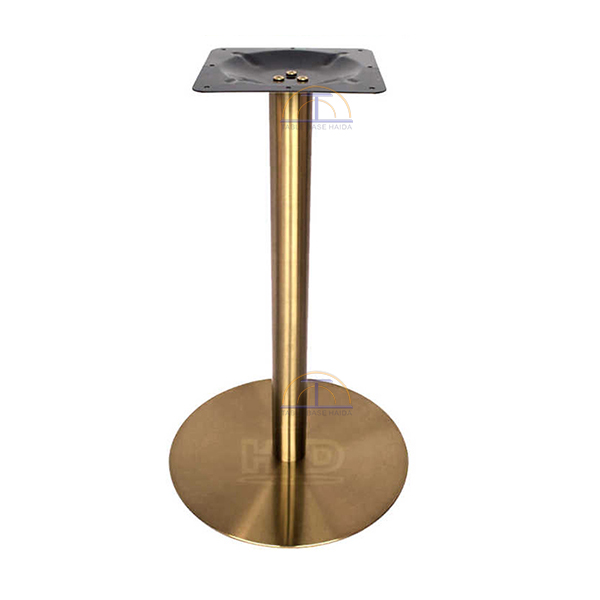
For commercial furniture importers, the value of a table base is not measured only by its factory unit price. Carton size, container loading, receiving efficiency, assembly labor, surface damage and spare-parts availability all influence the cost of bringing a product into stock or delivering it to a project.
Knock-down (KD) table bases separate selected components for transport and assembly. A well-designed KD packing plan can reduce unused shipping space and improve SKU handling, but it must also protect finishes, keep hardware complete and make assembly repeatable. This guide explains how to specify KD table bases from RFQ through repeat orders.
1. What Does KD Packing Mean for Commercial Table Bases?
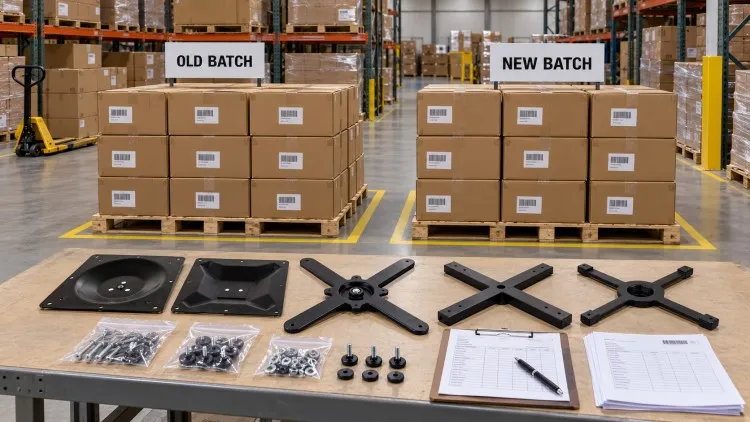
KD packing means that the supplier ships an approved set of components rather than necessarily shipping one fully assembled table base. Depending on the model, the floor base, column, mounting plate, screws and glides may be packed separately. A welded frame or folding mechanism may remain preassembled even when the product is sold as KD.
The buyer should approve the exact component breakdown for each SKU. “KD packing” alone does not define whether a model is packed one set per carton, two sets per carton, or in multiple cartons.
2. Compare KD and Assembled Bases on Total Landed Cost
KD packing may lower freight cost per table base when it improves carton and container utilization. However, additional protective material, hardware control, assembly labor, disposal of packing material and damage rates can change the final result. The best option should be compared at the complete delivered-and-ready-to-use level.
| Cost Factor | KD Packing | Fully/Partly Assembled |
| Transport volume | Often more compact if geometry allows | May consume more cube |
| Packaging protection | Needs part-by-part separation | Needs support around assembled geometry |
| Assembly labor | Required at destination | Lower or partial work |
| Hardware control | Critical to kit completeness | Fewer loose items in some designs |
| Damage exposure | Surface rubbing or missing parts possible | Bulky handling or deformation possible |
An importer should compare product price, packaging cost, freight, destination handling, assembly labor, damage allowances and replacement-parts support. Do not claim a fixed freight-saving percentage until the supplier provides actual carton data and a workable loading plan.
3. Build a Model-Level KD Packing Specification
Different table base structures require different packing decisions. The packing specification should identify exactly which parts are shipped loose, which parts stay assembled, and how each part is protected and identified. One standard carton format should not be copied across every model.
- Model and buyer SKU, including height and finish version
- Components per set and quantities per component
- Sets per carton and cartons per set
- Outer-carton dimensions and gross weight
- Internal partitions, surface wrapping and edge protection
- Hardware bag code and assembly-manual revision
- Carton mark, barcode and carton-number sequence
If the buyer operates many models, the SKU matrix guide can help separate core stock items, project-specific items and packing variants before the order is placed.
4. Product Examples: KD Risks Differ by Structure
The HD-JN03 self-leveling cast iron base is a cast iron model listed with KD packing at two sets per carton. Its self-leveling parts, glides and small hardware require clear separation and carton-level counting. The weight of cast iron components also makes internal protection important.
The HD-J044 twin-column cast iron base is listed with KD packing at one set per carton. A long-table base with two columns should be checked for complete column sets, top plates, fasteners, matching finishes and suitable protection for heavy components.
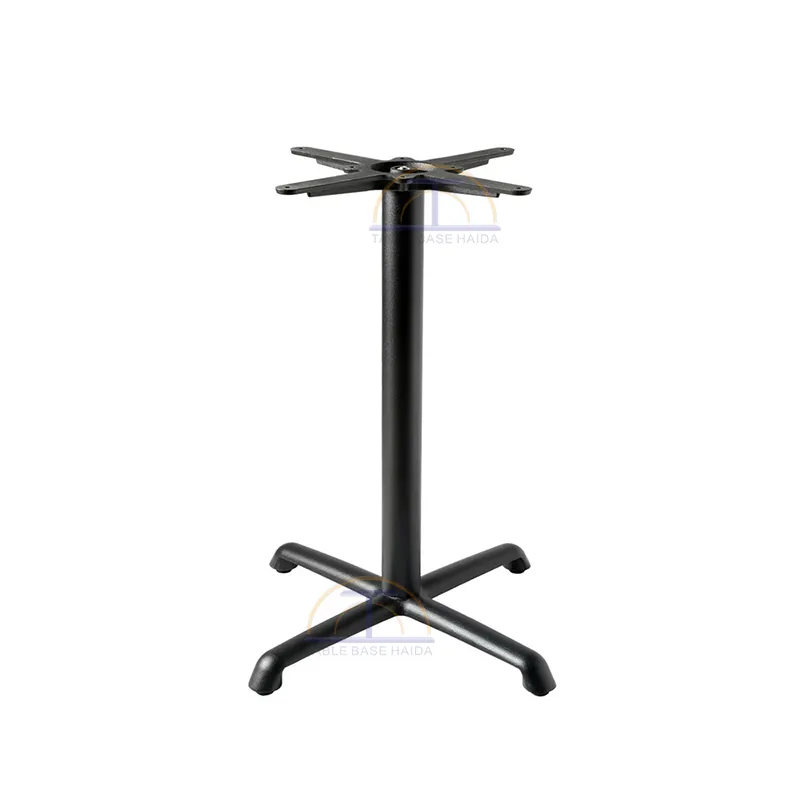
For the HD-J251 welded steel 4-leg base, importers should not assume that every welded leg can be separated. Confirm which welded parts remain intact, how protruding legs are protected, and whether the mounting hardware matches the approved tabletop.
The HD-JN02 stackable folding aluminum base combines a folding mechanism with KD packing at one set per carton. Receiving and assembly checks should include hinge movement, locking, frame contact points, protective pads and complete hardware.
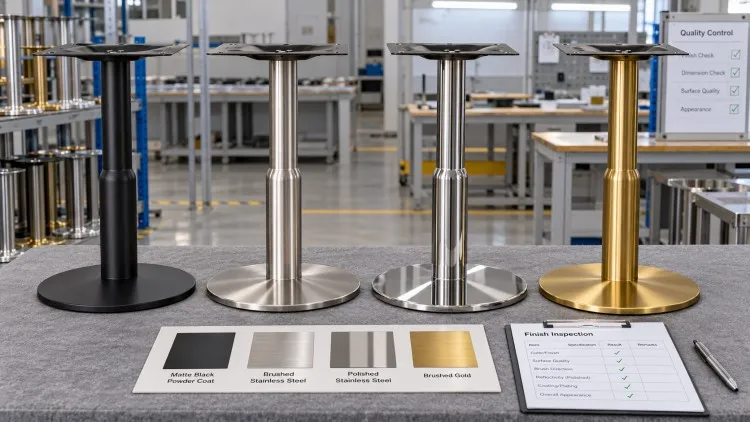
A finish-sensitive model such as the HD-J123 brushed stainless steel base needs protective separation that avoids abrasion between polished or brushed faces. Different materials and finishes change packing risk even when the carton quantity looks similar.
5. Protect the Finish, Not Only the Carton
An export carton can arrive intact while the parts inside are scratched. Heavy floor plates may damage columns or top plates if protective layers move during transit. Finished metal surfaces need suitable wraps and physical separation, especially at corners, weld areas and contact edges.
- Separate heavy cast iron parts from finished panels and columns
- Protect brushed or polished faces against direct contact
- Prevent bolts and hardware bags from moving into exposed finishes
- Check carton compression, puncture resistance and handling suitability
- Approve packing photographs and a representative transport-ready carton
6. Make Hardware Kits and Manuals Part of the Product
A KD base is not saleable or installable if the carton has a missing bolt, incorrect glide, mismatched thread or outdated manual. Each approved SKU should use a defined hardware kit with a part number and an item-by-item quantity list.
The installation manual should show component identification, tools, fastening sequence, tabletop attachment, leveling and safety checks. For OEM brands, the private-label packing guide covers carton marks, barcodes, hardware-bag labels and manuals in more detail.
7. Approve Trial Assembly Before Bulk Packing
The buyer should approve a fully assembled reference table base and its complete KD carton before mass packing. Trial assembly should use production-intent components and the same hardware, glides, top plate and instructions that will ship to customers.
Check hole alignment, connection fit, thread quality, installation sequence, tabletop mounting, leveling and the finished appearance. A separate sample approval checklist helps define the approved reference; the mounting-plate guide addresses hole patterns and fixing compatibility.
8. Calculate Loading by Carton Cube, Weight and Mix
Container planning should begin with approved external carton dimensions, gross weights and carton counts by SKU. Theoretical carton volume alone is not enough: safe stacking, weight distribution, pallet choice, handling gaps, container restrictions and loading sequence can reduce usable space.
Do not promise a fixed number of sets per 20GP or 40HQ without a model-specific packing list and loading layout. Compare proposed mixed-SKU quantities against carton dimensions, total gross weight and how the goods can actually be stowed.
For mixed-model imports, the packing plan should show carton counts by SKU, the loading sequence and how destination staff will identify and separate the cartons after unloading.
9. Standardize Carton Marks Across the Supply Chain
Carton marks should match the purchase order, supplier model, buyer SKU, packing list and warehouse record. At minimum, buyers should decide how to display the model, finish, height, quantity per carton and carton number. Barcodes or private-label graphics can be added when needed.
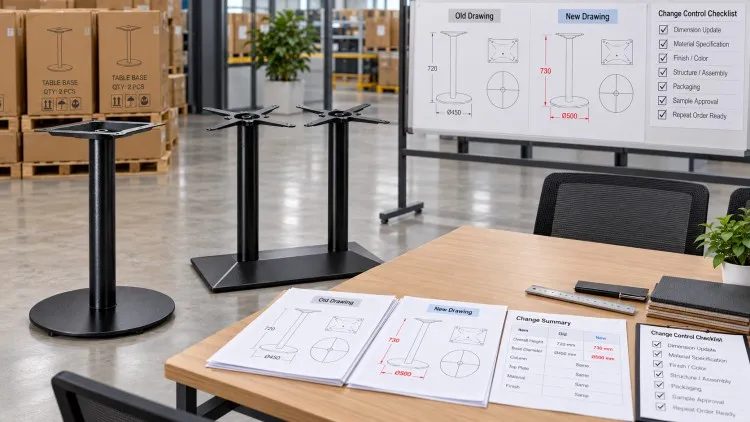
A black dining-height table base must not be confused with its bar-height or alternative-finish version. This becomes especially important when several similar-looking KD cartons arrive together.
10. Include Packing in Pre-Shipment Inspection
Before shipment, inspection should confirm the correct model and quantity, external carton marks, complete component list, hardware kits, manuals, surface protection and representative assembly. If the shipment contains multiple packing versions, inspectors must record each version separately.
The existing pre-shipment inspection checklist provides the detailed QC process. In this article, the main control point is simpler: the production carton must match the approved KD packing specification, not merely contain something that looks like the right table base.
11. Design the Packing for Warehouse Receiving
KD cartons should be easy to count, classify, inspect and release into stock at the destination warehouse. If the carton identity is unclear, the warehouse may have to open many boxes just to separate heights, colors and models.
The warehouse team should receive the approved packing list, carton numbering system and a photo reference before arrival. Damaged cartons should be documented and separated from accepted stock. The warehouse receiving checklist details the receiving and evidence steps.
12. Plan Destination Assembly and Installation Readiness
Importers selling through dealers should establish who performs assembly: their warehouse, a restaurant installer, the final customer or a contract-furniture team. The approved KD package should be workable with the tools and installation responsibilities at the destination.
Before large projects, verify the tabletop fixing method, availability of predrilled holes or inserts, correct fasteners, trial assembly and site delivery order. These coordination issues are described in the installation readiness guide.
13. Keep Spare Parts and Packing Versions Traceable
A dealer may need one replacement glide or a complete hardware bag months after the shipment. Spare parts should be identified by model, component version and thread or fixing specification instead of by vague descriptions such as “standard screw.”
The spare parts planning guide explains dealer support in more depth. Importers should also retain the packing version used for each repeat order, because a product can keep the same appearance while hardware, instructions or cartons change.
14. Send One Clear KD RFQ to Every Supplier
Use the same information sheet for every supplier so comparisons include identical packing and delivery assumptions. A quotation that says only “KD packing included” is not sufficient for container or warehouse planning.
| RFQ Field | What the Buyer Should Provide |
| Models and SKUs | Model list, versions, quantity by SKU |
| Tabletop | Shape, size, material, approximate weight |
| Base configuration | Material, height, finish, mounting plate and hardware |
| KD breakdown | Which parts are separated and which remain assembled |
| Cartons | Sets/carton, cartons/set, outer dimensions and gross weight |
| Packing marks | Buyer SKU, model, finish, height, barcode and labels |
| Supporting documents | Hardware list, assembly manual, sample and packing photos |
| Shipment | Target delivery, pallet policy and container-loading assumptions |
The RFQ checklist provides a broader table base purchasing specification. Include this KD-specific packing matrix when asking for a firm export quotation.
15. Common KD Purchasing Mistakes
- Assuming every KD model uses the same number of cartons
- Comparing unit price without destination assembly and handling cost
- Claiming freight savings without verified carton and loading data
- Ignoring protection between heavy parts and premium finishes
- Approving a product sample but not the final packed carton
- Using one barcode for different height or finish versions
- Shipping hardware without model-specific labels or a clear manual
- Failing to reserve matching replacement parts for repeat sales
16. How Haida Can Support KD Table Base Imports
Haida offers commercial cast iron table bases, steel table bases, stainless steel table bases and aluminum table bases for restaurants, hotels, cafes and furniture dealers. KD configurations, finishes and carton quantities vary by product model, so the correct packing specification should be confirmed for each approved SKU.
Send your model list, quantities, tabletop requirements, packing preferences, destination warehouse needs and target market. The team can review product configurations and quotation details through Haida table bases.
17. Conclusion
KD table bases can be an efficient import option when the packaging is designed around the actual product, container and destination operation. Freight volume alone is not the goal: the complete system must preserve finish quality, keep every part traceable, support accurate stock receiving and allow repeatable installation.
Before issuing a purchase order, approve the component breakdown, sets per carton, carton dimensions and weight, hardware kits, markings, packing sample and loading assumptions. That makes KD packing a controlled purchasing specification rather than an undefined promise on a quotation.
18. FAQ: KD Table Bases for Importers
1. What does KD mean for a commercial table base?
KD means selected components are packed separately for shipping and assembled later. The exact breakdown depends on the model; welded or folding subassemblies may remain intact.
2. Is KD packing always cheaper than assembled packing?
Not always. It can reduce shipping cube, but assembly labor, additional packing, handling and damage risk must be included in the total landed cost comparison.
3. How many KD table bases fit in a 40HQ container?
There is no universal answer. Capacity depends on the approved carton size, gross weight, stacking arrangement, SKU mix, pallet choice and actual loading restrictions.
4. Can different KD base models be mixed in one shipment?
Mixed-SKU orders can be planned if the supplier confirms carton counts, individual packing specifications, labels, total weight and a workable loading and receiving plan.
5. What should be inside a KD table base carton?
The carton should contain the approved components and hardware for the stated number of sets, with suitable protection and the correct assembly instructions or referenced manual.
6. Should buyers approve a packed sample?
Yes for new models, customized finishes and significant packing changes. The packed sample should be checked against the parts list, carton marks, protection layout and trial assembly.
7. What is the main receiving risk with KD shipments?
Model or height mix-ups, incomplete hardware, transport scratches and carton-count errors are important risks. A receiving checklist and SKU-specific labels help control them.
8. What information is needed for a KD table base quote?
Provide model and SKU quantities, tabletop requirements, finish, desired packing configuration, carton-mark needs, destination market and shipment schedule. Request carton dimensions and gross weight in the quotation.