1. Why a Complete Warranty Claim File Matters
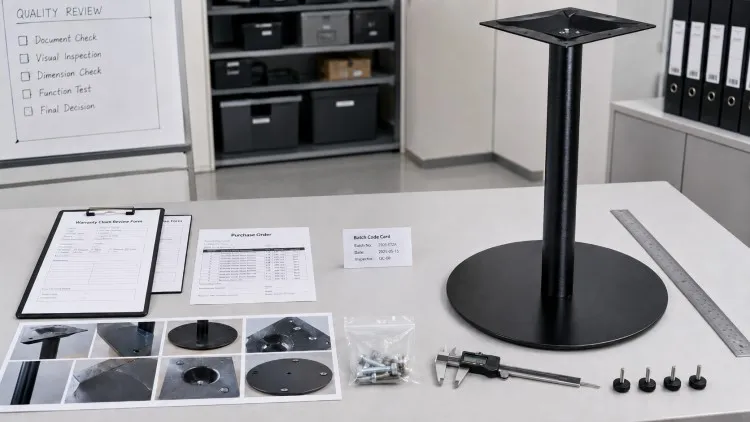
For commercial table base importers, a warranty claim should be based on clear evidence rather than a short message saying that the product is damaged or unstable.
A complete claim file helps the buyer and supplier identify the affected product, confirm the likely cause and decide whether the issue should be resolved through spare parts, rework, replacement or commercial credit.
It also reduces repeated questions and prevents unrelated problems from being grouped into one unclear complaint.
The goal of a claim file is not to make the process more complicated. It is to provide enough information for a practical decision.
2. Define the Claim Type Before Submitting It
Before opening a warranty claim, the importer should identify which type of problem has occurred.
A manufacturing defect, transport damage, missing part, installation error and normal wear may require different evidence and different solutions.
Common claim types include:
- Structural defect
- Welding defect
- Surface or finish defect
- Missing hardware
- Incorrect product or specification
- Packaging or transport damage
- Stability or wobble problem
- Folding or adjustment mechanism problem
- Installation-related problem
- Damage caused by unsuitable use
The claim category should be recorded at the beginning of the file so the supplier can assign the case to the correct production, quality or packing team.
3. Create a Unique Claim Reference Number
Every claim should have a unique reference number.
The same claim number should be used in emails, photos, videos, inspection forms, replacement-part requests and credit discussions.
Example claim reference:
CLM-2026-PO458-HD123-01
This code can represent the claim year, purchase order, product model and claim sequence.
A clear reference number prevents several complaints from different orders or customers from being mixed together.
4. Record the Original Order Information
The claim file should connect the affected product to the original commercial order.
Without the purchase order, invoice or shipment information, the supplier may not be able to confirm which production batch, material or packing version was supplied.
Order information should include:
- Buyer company name
- Supplier name
- Purchase order number
- Invoice number
- Shipment date
- Container or shipment reference
- Product model
- Ordered quantity
- Finish or color
- Packing version
- Delivery destination
A copy of the relevant purchase order line or invoice line should be attached when possible.
5. Identify the Product and Production Batch
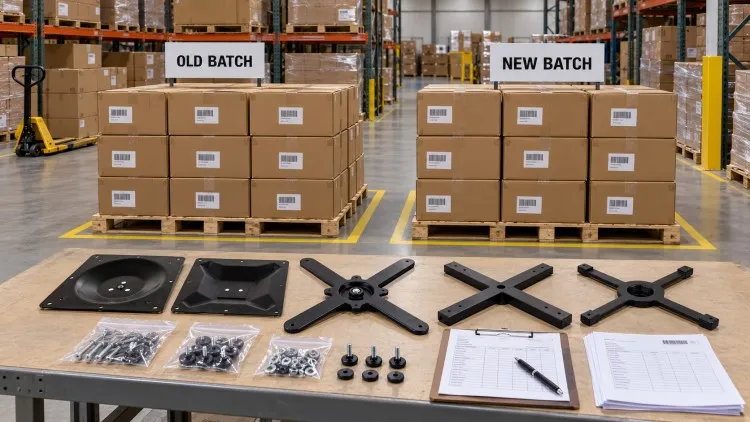
A product photo alone may not be enough to identify the correct table base version.
Similar models may use different heights, top plates, screws, finishes or packing configurations.
Product identification should include:
- Product model
- Buyer SKU
- Supplier item number
- Product label photo
- Carton label photo
- Batch number
- Production date, if available
- Finish and color
- Dining or bar height
- Hardware-bag code
Batch information helps the supplier check production records, inspection results and materials used for the affected order.
6. Quantify the Affected Products Clearly
The importer should state how many products were inspected and how many showed the reported problem.
A statement such as “many bases have defects” does not provide enough information for a commercial decision.
Quantity information should include:
| Field | Example |
|---|---|
| Total order quantity | 500 sets |
| Quantity received | 500 sets |
| Quantity inspected | 120 sets |
| Quantity affected | 8 sets |
| Defect rate in inspected sample | 6.7% |
| Locations affected | Two customer warehouses |
If only part of the shipment has been inspected, the claim file should not describe the issue as affecting the full order unless further inspection confirms it.
7. Take a Complete Set of Claim Photos
Good claim photos should show both the overall product and the specific defect.
A close-up photo without product identification may not prove which model or shipment is involved.
The standard photo set should include:
- Full carton before opening
- Carton mark and shipping label
- Internal packing condition
- Full product from several angles
- Product label or batch code
- Close-up of the defect
- Defect shown with a ruler or measuring tool
- Installed product, when the issue appears after installation
- Comparison with a normal product
- Tabletop and floor condition, when stability is involved
Photo file names should include the claim number, model and sequence.
8. Use Videos for Functional Problems
Some table base problems cannot be shown clearly in still photos.
Videos are especially useful for wobble, movement, folding, adjustment, noise and loose connections.
A useful claim video should show:
- The full product before testing
- Product label or model
- Floor condition
- Tabletop installed on the base
- How pressure is applied
- The reported movement or noise
- The affected joint, glide or mechanism
- Comparison with a normal unit, if available
The video should be continuous where possible so the supplier can understand the test conditions.
9. Match Evidence to the Product and Defect Type
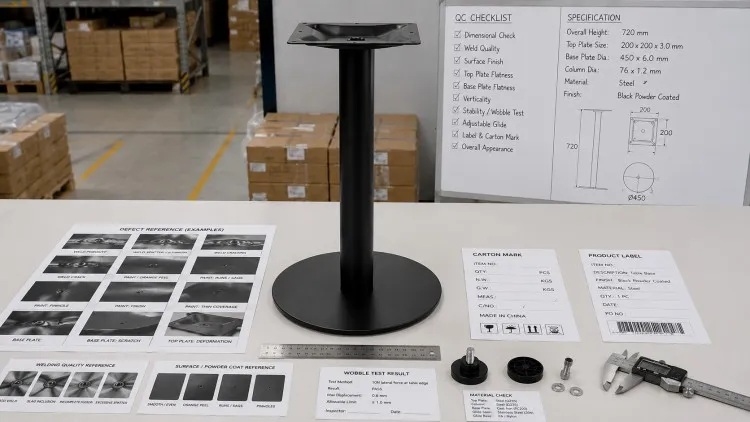
Different table base structures require different claim evidence.
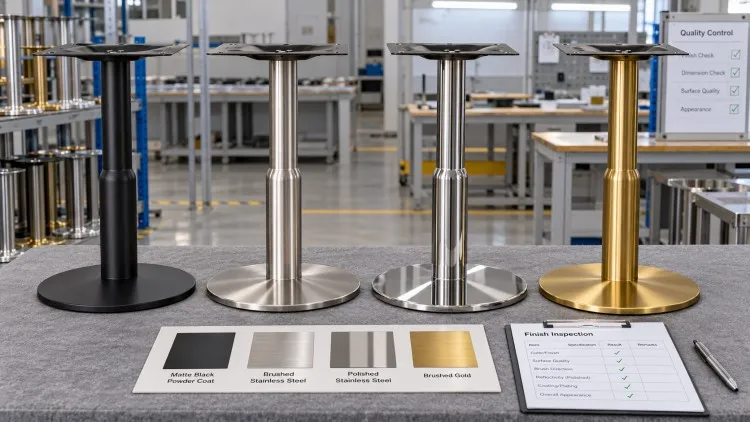
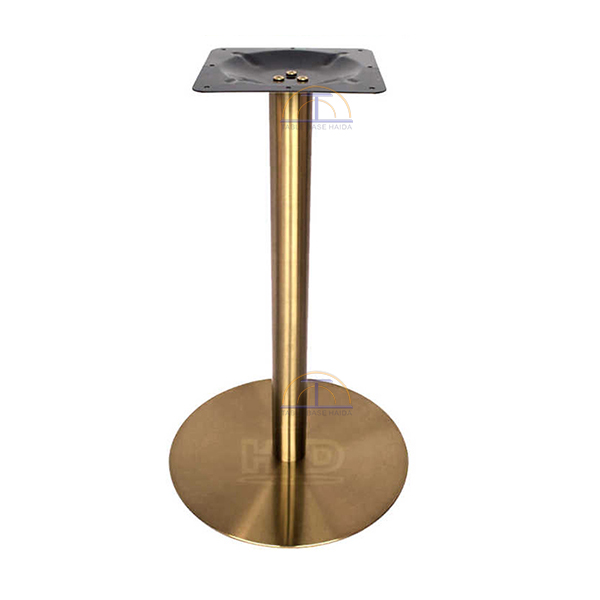
- For a brushed product such as the Brushed Stainless Steel Table Base HD-J123, a surface claim should show the direction and consistency of the brushing, the affected area under neutral lighting and whether the mark remains after normal cleaning.
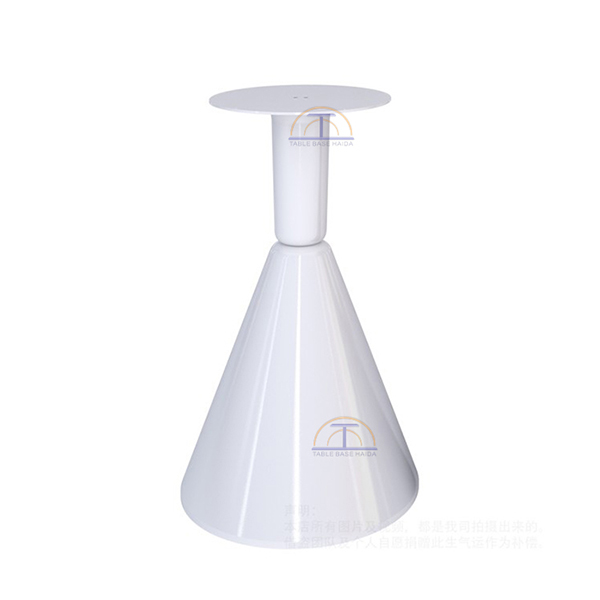
- For a formed pedestal product such as the Brushed Conical Stainless Steel Base HD-J275, photos should show whether the issue affects only the visible finish or also changes the shape, alignment or stability of the conical structure.
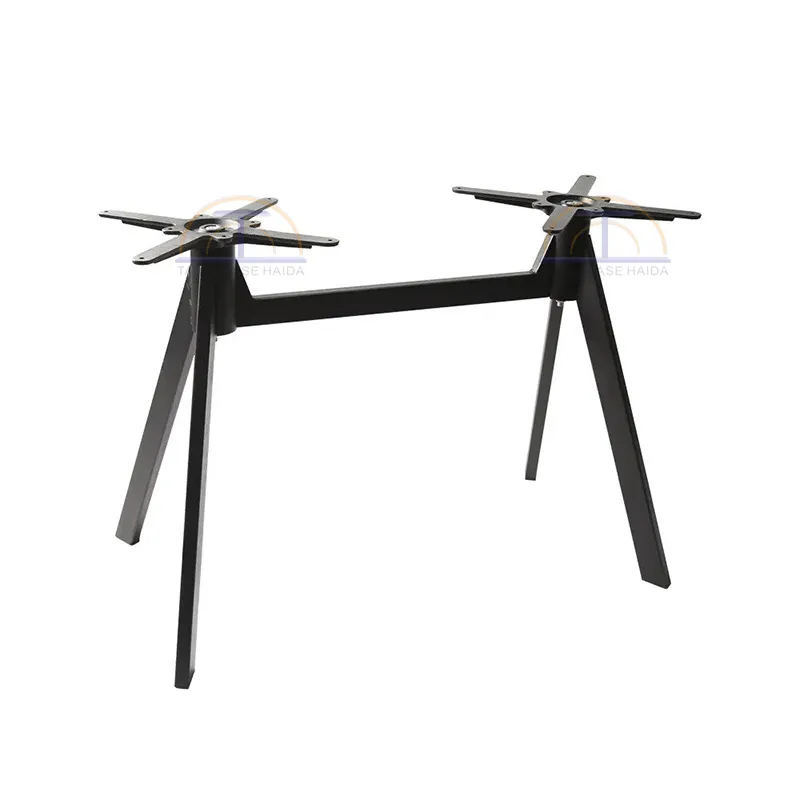
- For a welded structure such as the Modern Steel 4-Leg Base HD-J251, a structural claim should include clear photos of the welds, leg alignment, top plate, connection points and the complete base standing on a level surface.
- For a heavy cast iron product such as the Heavy-Duty Cast Iron X-Base HD-J053, stability claims should show the X-base footprint, glides, column connection, tabletop size and whether all contact points touch the floor.
The evidence should be selected according to the product structure rather than using the same photo checklist for every model.
10. Separate Transport Damage From Manufacturing Defects
Transport damage and manufacturing defects should not be documented in the same way.
If the carton is crushed, punctured, wet or opened during transport, the claim file should show the external packaging condition before the product is removed.
Transport-damage evidence should include:
- Full carton photos
- Damaged carton area
- Shipping label
- Container or pallet condition
- Internal protective materials
- Product position inside the carton
- Damage found immediately after unpacking
- Carrier delivery receipt or exception note
If the outer carton is undamaged but the same defect appears on several products, the issue may require further production or packing investigation.
11. Verify Installation Conditions
Not every stability or alignment complaint is caused by the table base itself.
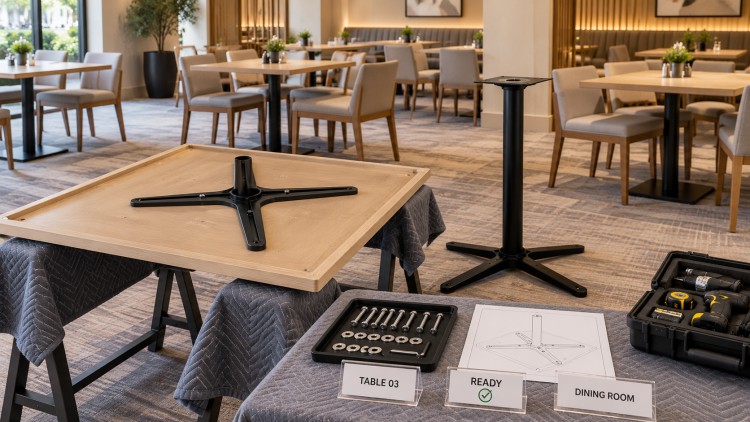
The supplier may need to confirm the tabletop, screws, mounting holes, floor and assembly method before deciding the claim.
Installation evidence should include:
- Tabletop shape and size
- Tabletop material and approximate weight
- Tabletop thickness
- Screw type and length
- Mounting-hole position
- Hardware used
- Assembly sequence
- Floor level or slope
- Adjustment of leveling glides
- Whether the installation follows the supplied instructions
If the tabletop is larger or heavier than the approved specification, this should be disclosed in the claim file.
12. Record Measurements Instead of Using General Descriptions
Measurements make a claim easier to evaluate.
Descriptions such as “too short,” “not straight” or “large gap” should be supported by actual dimensions.
Useful measurements include:
- Overall height
- Base width or diameter
- Column vertical alignment
- Top plate size
- Mounting-hole distance
- Gap between components
- Glide adjustment range
- Surface scratch length
- Dent depth or damaged area
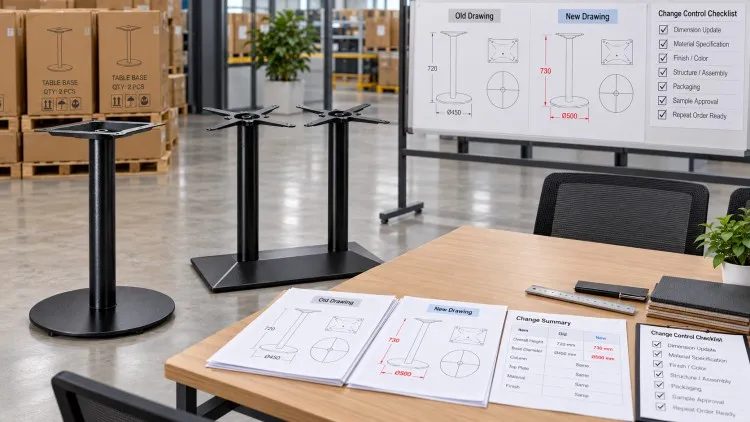
- Difference compared with an approved sample
Photos should show the measuring tool and measurement point clearly.
13. Decide the Most Practical Resolution
Not every claim requires replacement of the complete table base.
Small issues may be resolved more efficiently through spare parts or local rework.
Possible resolutions include:
| Issue | Possible Resolution |
|---|---|
| Missing screws or glides | Send replacement hardware |
| Damaged hardware bag | Send complete hardware kit |
| Minor removable surface mark | Cleaning or maintenance guidance |
| Replaceable damaged component | Send replacement component |
| Local repair possible | Agree on rework method or allowance |
| Incorrect specification | Replace affected units |
| Serious structural defect | Replace complete base |
| Small confirmed commercial loss | Credit on current or future order |
The selected solution should consider defect severity, product value, freight cost, installation status and customer urgency.
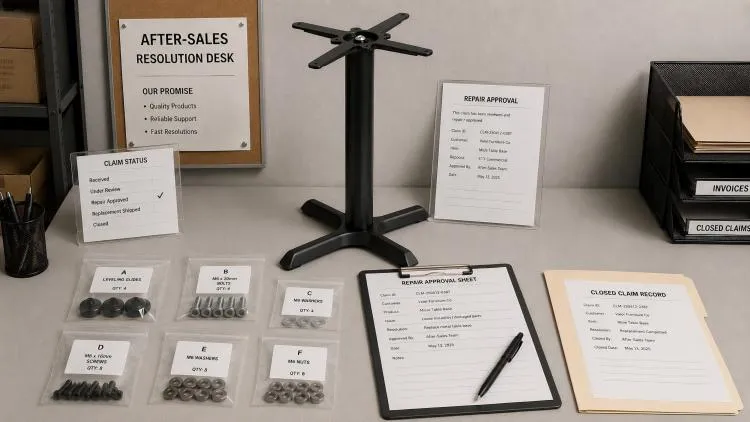
14. Define the Claim Review Workflow
A clear workflow helps prevent claims from remaining open without ownership.
A practical claim workflow can include:
- Importer submits claim reference and initial evidence
- Supplier confirms receipt of the claim
- Supplier checks whether additional evidence is required
- Production, quality or packing team reviews the case
- Likely cause is recorded
- Proposed resolution is issued
- Buyer approves or comments on the resolution
- Replacement, spare parts, rework or credit is completed
- Claim is closed with a final record
The importer and supplier should agree on who is responsible for each step and the expected response time.
15. Maintain a Claim Tracker
Importers should keep a central tracker for all table base warranty claims.
This makes it easier to identify repeated problems, unresolved cases and models that require more spare-parts support.
A claim tracker can include:
- Claim reference
- Customer or project
- Purchase order
- Product model
- Batch number
- Claim category
- Quantity affected
- Date reported
- Evidence received
- Likely cause
- Proposed resolution
- Resolution cost
- Current owner
- Claim status
- Closing date
The tracker should separate open, pending-evidence, approved and closed claims.
16. Use Claim Records for Root-Cause Improvement
A warranty claim should not end only with replacement or compensation.
Repeated claim data can help the importer and supplier improve product specifications, inspection, packing and customer instructions.
Claim records can reveal:
- Repeated defects from one model
- Problems linked to one production batch
- Frequent missing hardware
- Damage related to carton design
- Incorrect installation by customers
- Products matched with unsuitable tabletops
- Spare parts that should be stocked locally
- Product instructions that require revision
The most useful claim system is one that reduces the chance of the same issue occurring again.
17. Common Warranty Claim Mistakes
Incomplete evidence can delay or weaken an otherwise valid claim.
Common mistakes include:
- No purchase order or invoice reference
- No product model or batch number
- Only one close-up photo
- No full-product photo
- No carton-condition evidence
- No quantity breakdown
- Photos from different products mixed together
- Wobble complaint without tabletop or floor information
- No measurements
- Requesting full replacement before identifying the cause
- Several unrelated defects submitted under one claim number
A well-organized claim file makes it easier for both parties to focus on the actual problem and resolution.
18. How Haida Supports Table Base Warranty Claims
Commercial table base claims are easier to review when product, batch, packaging and installation information are clearly recorded.
Haida can support importers, dealers and project buyers with product identification, hardware confirmation, replacement-parts matching and claim review based on the available order records and evidence.
To submit a table base quality or after-sales case, buyers can contact Haida for warranty claim support with the purchase order, model, batch code, affected quantity, photos, videos and requested resolution.
19. FAQ
Q1: What should be included in a table base warranty claim?
A claim should include the purchase order, product model, batch number, affected quantity, carton photos, product photos, defect close-ups, measurements and requested resolution.
Q2: Are photos enough for a wobble claim?
Usually not. A video should show the installed tabletop, floor condition, leveling glides, pressure test and the reported movement.
Q3: How should transport damage be documented?
Photograph the carton, shipping label, damaged area, internal packing and product position before discarding the packaging.
Q4: Does every claim require a complete product replacement?
No. Missing hardware, damaged glides and replaceable components may be resolved through spare parts, while serious structural defects may require full replacement.
Q5: Why is the batch number important?
The batch number helps the supplier check production, inspection, material and packing records for the affected products.
20. Conclusion
A commercial table base warranty claim should be supported by organized and verifiable evidence.
The claim file should connect the problem to the correct order, model, batch, quantity, packaging and installation conditions.
Photos, videos and measurements should show what happened, how many products are affected and whether the problem is structural, cosmetic, functional, transport-related or installation-related.
When the importer and supplier follow one clear claim workflow, they can select a more practical solution and use the result to reduce repeated problems in future orders.