1. Why Warehouse Receiving Inspection Is Different From Factory QC
A table base order can pass factory inspection and still arrive at the buyer’s warehouse with new problems.
Ocean freight, container loading, pallet movement, repeated handling, unloading and warehouse transfer all introduce risks that do not exist at the factory inspection stage.
For importers and dealers, receiving inspection should therefore answer a different question:
Did the buyer receive the correct quantity and specification in usable condition after transportation?
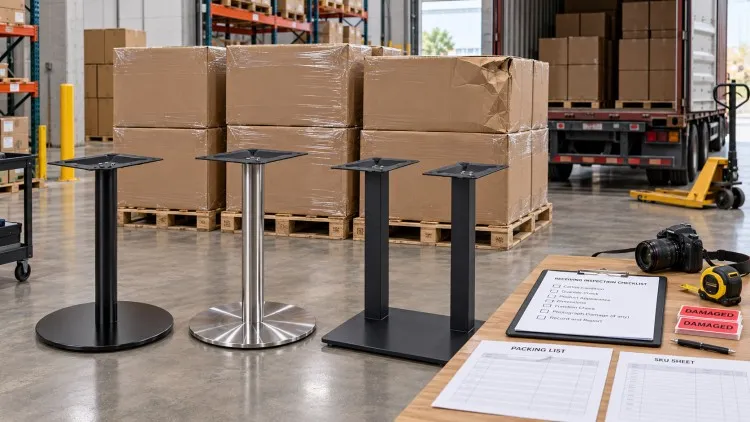
The receiving process should focus on shipment identity, carton condition, shortages, transport damage, product condition and evidence collection.
2. Use the Pre-Shipment Inspection Report as the Baseline
Warehouse receiving should not start from zero.
The earlier Commercial Table Base Pre-Shipment Inspection Checklist establishes what was checked before the goods left the supplier.
That report becomes a useful comparison point after transportation.
Before receiving starts, the warehouse team should have access to:
- Purchase order
- Commercial invoice
- Packing list
- Supplier model list
- Buyer SKU list
- Pre-shipment inspection report
- Carton quantity
- Pallet quantity
- Finish and height versions
- Photos taken before shipment when available
The goal is to compare what was shipped with what actually arrived.
3. Prepare the Receiving Area Before Unloading
Receiving inspection becomes difficult when several models are unloaded into one mixed warehouse area without a plan.
Before unloading, create temporary receiving zones for different SKUs, heights or finish versions.
Useful preparation can include:
- Receiving zone labels
- SKU identification sheets
- Camera or mobile phone
- Marker pens
- Damage labels
- Quarantine labels
- Utility knife
- Measuring tape
- Basic assembly tools
- Receiving inspection sheet
Do not mix inspected, uninspected and damaged cartons in the same area.
4. Inspect the Container, Truck or Pallets Before Unloading
Receiving evidence should begin before the first carton is moved.
Check the visible condition of the container, truck or pallets.
Record:
- Overall loading condition
- Shifted pallets
- Fallen cartons
- Crushed carton rows
- Visible water exposure
- Broken pallet boards
- Loose wrapping
- Punctures or impact marks
- Unusual empty spaces
- Signs of rehandling
Take overview photos before unloading changes the original condition.
5. Record Container or Delivery Identification
For container shipments, the receiving record should identify which shipment the evidence belongs to.
Useful identifiers can include:
- Container number
- Seal number
- Bill of lading reference
- Delivery date
- Carrier or forwarder
- Purchase order number
- Warehouse location
- Receiving employee
- Time unloading started
This helps connect later damage or shortage evidence to the correct shipment.
6. Count Cartons and Pallets Before Detailed Inspection
The first warehouse control point is quantity.
Compare the physical shipment against the packing list.
Check:
- Total pallets received
- Total cartons received
- Cartons per pallet
- Carton numbers
- Missing carton numbers
- Duplicate carton numbers
- Opened cartons
- Loose components
- Unexpected cartons
A shipment should not be accepted into normal stock before significant quantity differences are investigated.
7. Separate the Shipment by Model, SKU, Height and Finish
Commercial table base orders often contain products that look similar from the outside.
A black dining-height base and a black bar-height base may use similar cartons but belong to completely different warehouse SKUs.
Separate the received goods by:
- Supplier model
- Buyer SKU
- Material
- Height
- Finish
- Color
- Packing version
- Project or customer allocation
Do this before opening large numbers of cartons.
8. Inspect External Carton Condition
Carton condition is one of the most important receiving indicators.
A damaged carton does not automatically mean the product is damaged, but it identifies a higher-risk unit that should be inspected first.
Look for:
- Crushed corners
- Punctures
- Tears
- Wet areas
- Water stains
- Broken tape
- Re-taped cartons
- Open seams
- Abrasion
- Heavy impact marks
- Deformed cartons
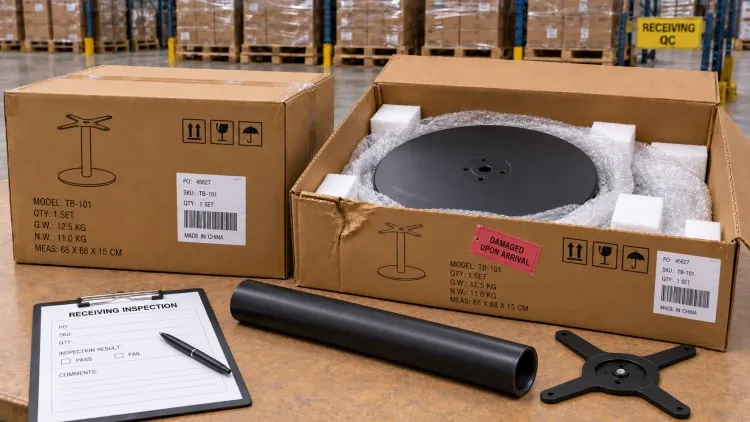
Mark damaged cartons before they are mixed with normal stock.
9. Photograph Carton Damage Before Opening
Evidence should show the packaging condition before the product is removed.
For a damaged carton, photograph:
- Full carton
- Carton mark
- Shipping label
- Damaged area
- Carton number
- Pallet position when relevant
- Adjacent damaged cartons
- Internal packing immediately after opening
Do not discard the carton or protective materials before the receiving issue is documented.
10. Prioritize High-Risk Cartons for Opening
Not every carton necessarily requires the same receiving inspection level.
Higher-risk cartons should normally be opened first.
Examples include:
- Crushed cartons
- Wet cartons
- Punctured cartons
- Cartons from shifted pallets
- Heavy bases with visible carton deformation
- Premium brushed or polished finishes
- Folding mechanisms
- Mixed-model cartons
- Products with prior shipment issues
Additional random cartons from apparently normal areas should also be checked.
11. Inspect Internal Packing Condition
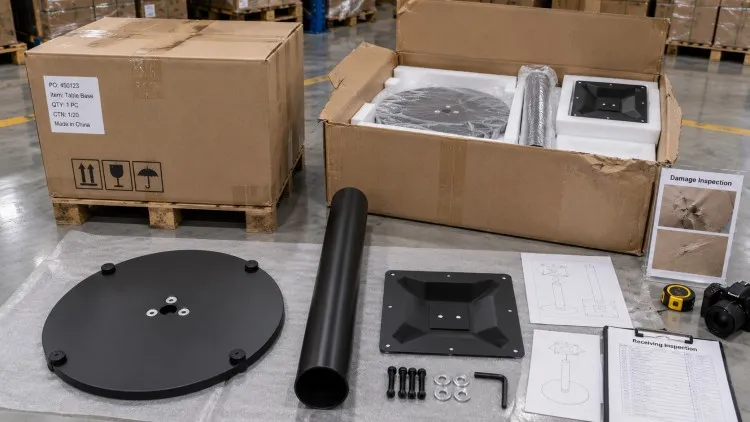
Once the carton is opened, inspect how the components moved during transportation.
Review:
- Internal partitions
- Foam or protective material
- Plastic bags
- Surface wrapping
- Edge protection
- Separation between metal parts
- Hardware bag position
- Loose components
- Movement marks inside the carton
- Compression of protective materials
If two finished metal parts have rubbed directly against each other, inspect both surfaces carefully.
12. Verify Product Identity After Opening
The warehouse should confirm that the physical product matches the carton label.
Check:
- Product model
- SKU
- Base shape
- Column structure
- Height version
- Finish
- Color
- Top plate type
- Folding or fixed structure
- Product label or batch label
Incorrect labeling can create stock errors even when the product itself is undamaged.
13. Inspect Transport Damage by Material and Structure
Different table base structures show transport damage in different ways.
A heavy cast iron base may create carton compression or damage nearby components if internal separation fails.
A formed stainless steel pedestal may be more sensitive to visible dents or surface marks.
A welded steel leg structure should be checked for bent legs, alignment changes or damaged coating.
Lightweight aluminum folding products require particular attention to mechanisms, frame contact points and scratches caused by movement during transit.
14. Product Examples: Different Receiving Risks
Different products require different receiving priorities.
The Commercial Cast Iron Self-Leveling Table Base HD-JN03 uses a cast iron structure with self-leveling glides and KD packing. At receiving, buyers should confirm that heavy components have not damaged the carton, that the glides and hardware are present, and that the base, column and top plate have remained separated and protected during transport.
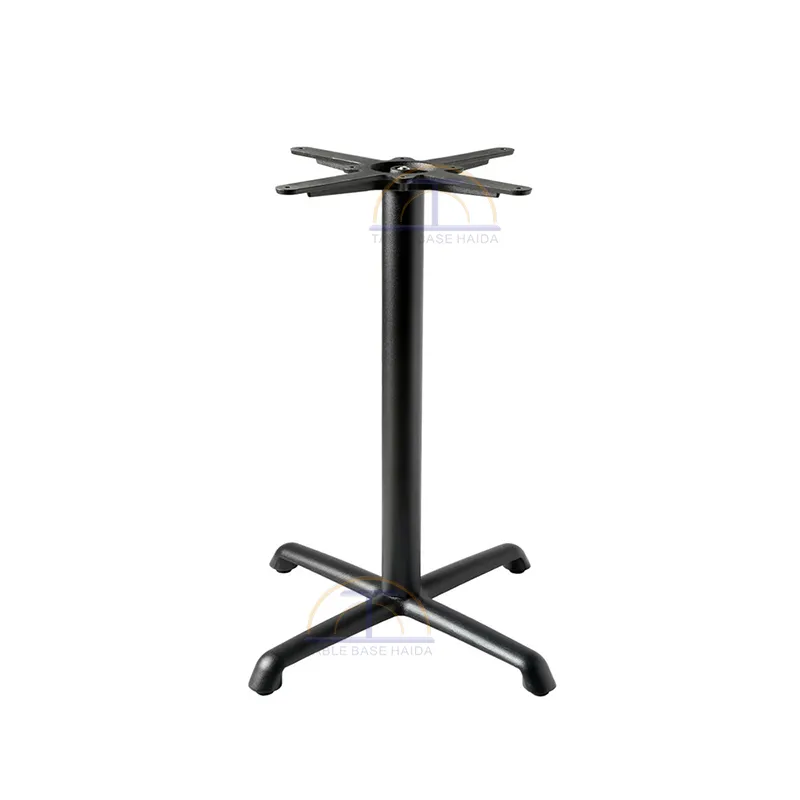
The Modern Steel 4-Leg Base HD-J251 is a welded steel four-leg structure. For this type of product, receiving inspection should look for leg deformation, coating damage, weld-area impact, top-plate damage and changes in alignment after transportation.
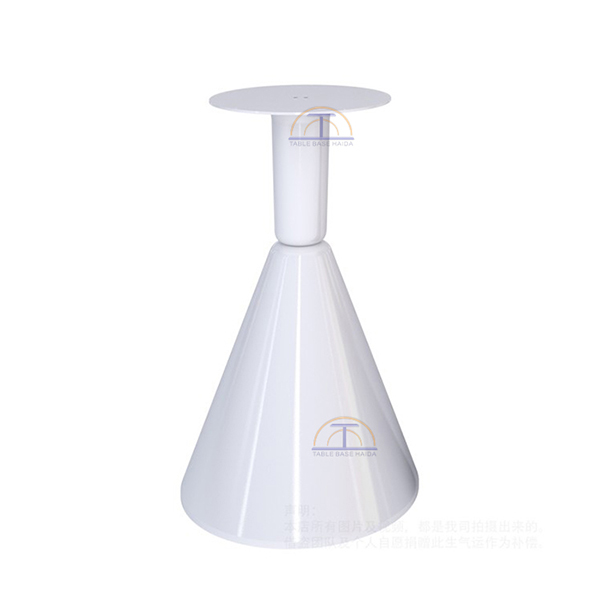
The Brushed Conical Stainless Steel Base HD-J275 uses a formed conical stainless steel structure with a brushed finish and KD packing. Receiving inspection should pay particular attention to dents, finish scratches, protective wrapping, top-plate condition and surface consistency after unpacking.
The Outdoor Stackable Aluminum Folding Table Base HD-JN02 combines an aluminum frame, folding top mechanism, stackable structure and KD packing. Its receiving inspection should include frame scratches, folding movement, locking function, top-plate condition, hardware completeness and contact marks created during transportation.
These products illustrate different receiving risks rather than universal acceptance standards.
15. Check Surface Damage Under Neutral Lighting
Warehouse lighting can hide scratches, dents and finish differences.
When finish appearance matters, move representative units into consistent neutral lighting.
Look for:
- Scratches
- Chips
- Dents
- Rub marks
- Protective-film damage
- Color variation
- Finish contamination
- Edge damage
- Exposed metal
Receiving records should distinguish transport damage from pre-existing production defects when possible.
16. Verify Hardware Bags, Manuals and Small Components
Small components are easy to lose during transport or unpacking.
For KD table bases, check whether each sampled carton contains the correct hardware and accessories.
Typical items include:
- Bolts
- Screws
- Nuts
- Washers
- Adjustable feet
- Glides
- Allen key
- Model-specific connectors
- Assembly manual
A carton with a complete table base but missing hardware is not ready for normal sale or project installation.
17. Perform Receiving Trial Assembly on Representative Units
Opening a carton is not enough to prove that the table base is usable after transport.
Representative receiving samples should be assembled where practical.
Trial assembly can reveal:
- Bent components
- Damaged threads
- Missing hardware
- Incorrect hardware
- Hole mismatch
- Alignment changes
- Base rocking
- Folding mechanism damage
- Incorrect manual
A small receiving assembly sample is particularly useful for shipments that experienced visible pallet or carton damage.
18. Separate Transport Damage From Manufacturing Defects
Warehouse teams should avoid automatically describing every defect as “supplier quality.”
A crushed carton with a dented product may indicate transport damage.
Repeated identical defects inside undamaged cartons may require investigation of production or packing.
Useful evidence includes:
- Outer carton condition
- Internal packing
- Product position
- Same defect across several units
- Pre-shipment photos
- Inspection report
- Pallet condition
- Carrier exception notes
The Commercial Table Base Warranty Claim Checklist for Importers provides a more detailed framework for documenting transport damage, production defects and claim evidence.
19. Quarantine Damaged or Unclear Stock
Products with unresolved receiving issues should not be mixed into normal stock.
Create a clearly marked quarantine area.
Quarantine labels can include:
- PO number
- SKU
- Model
- Carton number
- Quantity
- Issue type
- Date received
- Photo reference
- Inspection status
- Release status
This prevents damaged goods from being shipped to customers before the issue is reviewed.
20. Build a Receiving Inspection Record by SKU
The warehouse should record receiving results by product rather than creating only one shipment-level note.
A useful receiving record can include:
|
Field |
Receiving Record |
|
PO |
Buyer purchase order |
|
Container / Delivery |
Shipment reference |
| Model |
Supplier model |
| SKU |
Buyer SKU |
| Expected Qty. |
Packing-list quantity |
|
Received Qty. |
Physical count |
|
Damaged Cartons |
Number recorded |
| Opened Cartons |
Number inspected |
| Product Damage |
Quantity affected |
|
Missing Hardware |
Quantity affected |
| Trial Assembly |
Pass / issue |
| Quarantine Qty. |
Quantity isolated |
| Photo Reference |
Evidence file |
| Final Status |
Release / hold / claim |
This record becomes useful for inventory control, supplier communication and future quality comparison.
21. Record Carrier Exceptions Immediately
If obvious damage is visible at delivery, do not wait until several days later to create the first record.
Where applicable to the shipment and carrier process, record visible exceptions at the time of delivery.
Examples include:
- Missing pallets
- Crushed shipment
- Wet cartons
- Broken pallet
- Open cartons
- Visible product exposure
- Major carton punctures
Keep copies of the delivery record and related photos.
Specific carrier notification deadlines depend on the transport agreement and should be confirmed with the buyer’s logistics provider.
22. Do Not Release Stock Before Receiving Exceptions Are Resolved
Receiving inspection should end with a stock-release decision.
Typical statuses can include:
Released: Goods can enter normal inventory.
Released With Note: Minor documented issue does not prevent normal use.
Hold: Further inspection is required.
Quarantine: Affected goods must remain separated.
Claim Review: Evidence has been collected for supplier, carrier or insurer review.
The warehouse system should reflect the physical status of the goods.
23. Keep Receiving Evidence for Future Replacement and Repeat Orders
Receiving records are useful beyond the first days after delivery.
They can help later with:
- Identifying affected batches
- Warranty communication
- Replacement requests
- Spare-parts requests
- Comparing suppliers or batches
- Improving future packaging
- Adjusting warehouse handling
- Repeat-order specifications
A clear receiving record makes later discussions more specific and easier to verify.
24. How Haida Supports Imported Table Base Receiving
Haida supplies cast iron, steel, stainless steel and aluminum commercial table bases with different KD packing, finishes and structural configurations.
For importers and dealers, receiving becomes easier when the purchase order, model number, SKU, height, finish, carton mark and packing list use consistent identification.
For mixed-model orders, buyers should request clear model and carton identification before shipment so warehouse staff can separate and check stock efficiently after delivery.
Buyers can contact Haida for commercial table base order, packing and receiving coordination with their model list, quantity, target market and warehouse requirements.
25. FAQ
Q1: What is the difference between pre-shipment inspection and receiving inspection?
Pre-shipment inspection checks the product before it leaves the supplier. Receiving inspection checks what actually arrives after transportation, including shortages, carton damage, transport damage and warehouse identification.
Q2: Should every carton be opened at the warehouse?
Not always. The buyer should define the receiving plan based on shipment risk, product value and prior experience. Damaged cartons should normally receive priority, together with random checks from visually normal cartons.
Q3: What should be photographed when a carton is damaged?
Photograph the full carton, carton mark, shipping label, damaged area, pallet position when relevant, internal packing and product condition immediately after opening.
Q4: When should table bases be quarantined?
Products should be held or quarantined when damage, quantity differences, incorrect specification, missing hardware or other receiving exceptions have not yet been resolved.
Q5: Is trial assembly useful during receiving inspection?
Yes. Representative trial assembly can identify bent components, damaged threads, missing hardware, alignment issues and mechanism damage that may not be visible in loose components.
Q6: How should transport damage and supplier defects be separated?
Use carton condition, internal packing, pre-shipment evidence, repeated defect patterns, pallet condition and product photos together. Some cases require joint review with the supplier, carrier or logistics provider before responsibility can be determined.
26. Conclusion
Receiving inspection is the buyer’s first quality-control checkpoint after international transportation.
It should confirm not only whether the goods arrived, but whether the correct models, SKUs and quantities arrived in usable condition.
Importers and dealers should inspect shipment quantity, carton condition, internal packing, product identity, finish, hardware, functional parts and representative assembled units.
Damaged or unclear goods should be quarantined until the issue is documented and resolved.
When warehouse receiving records are connected to the purchase order and pre-shipment inspection report, transport damage, supplier issues and inventory differences become easier to identify and manage.