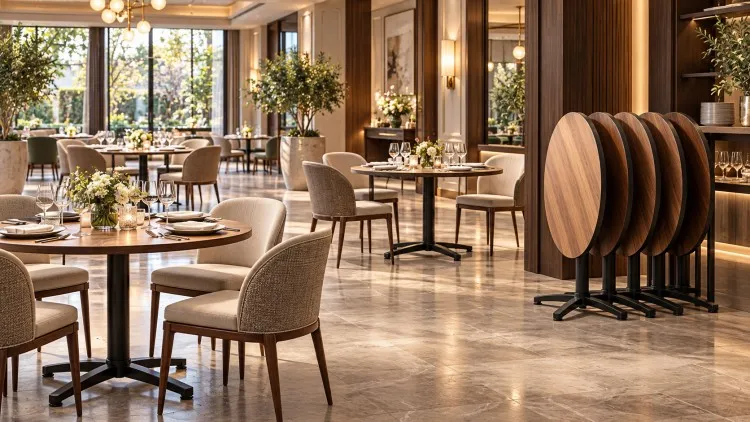
For restaurants, cafes and hotels, an outdoor table is more than a tabletop placed on a metal pedestal. Rain, humidity, sunlight, cleaning routines, uneven paving and wind all affect how the complete table performs over time.
Choosing the best outdoor table base therefore requires more than comparing unit prices or selecting the heaviest model. Buyers need to match the site conditions with the base material, footprint, tabletop, finish, mobility and storage requirements.
This commercial buying guide explains how to choose a practical base configuration and compare available models. For detailed finish tests, coating specifications and technical acceptance criteria, use the separate Outdoor Table Base Checklist.
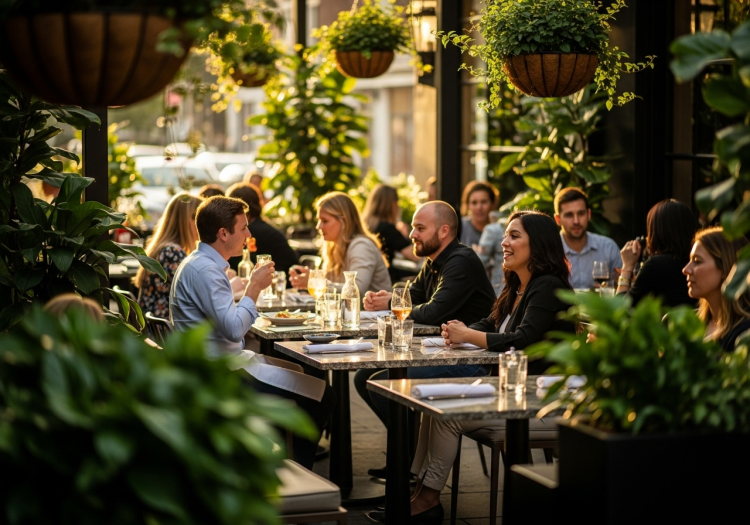
1. Start With the Outdoor Setting, Not the Product Photo
Two patios may look similar but need different table bases. A sheltered courtyard cafe usually prioritizes easy handling and cleaning. A fully exposed rooftop, wind corridor or seaside restaurant requires more careful review of stability, corrosion exposure and maintenance.
Before choosing a model, classify the project as covered outdoor, open patio, exposed rooftop, coastal, poolside or seasonal seating. Also determine whether the tables remain in place or are moved after each service.
- Site exposure: rain, sun, salt air and cleaning chemicals
- Table movement: fixed, daily repositioning or seasonal storage
- Floor conditions: flat paving, slopes, tile joints and drainage
- Wind exposure: sheltered area, corners, rooftops or open frontage
- Guest use: compact two-top, larger dining, bar-height or shared tables
2. Compare Outdoor Table Base Materials by Trade-Offs
Aluminum, stainless steel and coated cast iron are common commercial options, but none has an unconditional advantage. Material choice affects handling, corrosion risk, base mass, appearance and maintenance. A well-matched complete table matters more than a simple “best material” ranking.
|
Material |
Why buyers consider it |
Main buying checks |
| Aluminum | Lower weight and convenient handling for changing patio layouts | Review footprint, wind exposure, alloy/finish and hardware |
| 304 Stainless Steel | Clean metal appearance and good general corrosion resistance | Assess chloride exposure, joints, cleaning and grade verification |
| 316 Stainless Steel | Improved chloride-related pitting resistance compared with 304 | Higher cost; still needs correct design and maintenance |
| Coated Cast Iron | Substantial base weight and a traditional commercial appearance | Check coating integrity, corrosion points and handling effort |
| Coated Steel | Flexible fabricated structures and frame designs | Confirm outdoor finishing system, weld coverage and hardware |
If staff regularly rearrange tables, review the Aluminum Table Base Collection first. For projects prioritizing a stainless metal appearance, compare the Stainless Steel Table Bases range. For heavier traditional base designs, consider Cast Iron Table Bases with a verified outdoor finish.
Coastal exposure deserves a separate material decision. Read the Coastal Outdoor Table Bases: 304 vs 316 Guide before assuming that any stainless grade or aluminum finish is automatically suitable for seaside use.
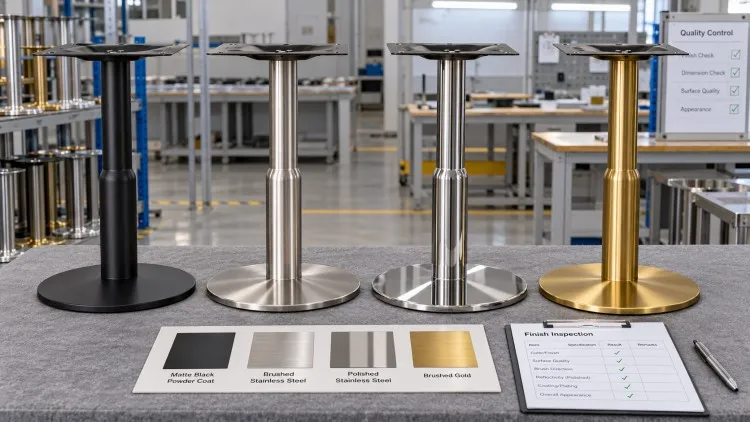
3. Evaluate Finishes Without Relying on “Rust-Proof” Claims
The term “rust-proof” is not a complete specification. Aluminum can oxidize or suffer finish deterioration; stainless steel can corrode under unfavorable chloride and crevice conditions; coated iron and steel depend on protective coating coverage.
Ask suppliers to identify the substrate, pretreatment, finishing process, finish reference and any project-specific testing requirements. Avoid treating one salt-spray hour figure or one coating thickness as a universal standard for every outdoor base.
For detailed evaluation of coating coverage, hidden corrosion points, fasteners, salt-spray methods and outdoor inspection criteria, follow the Outdoor Table Base Checklist rather than duplicating all technical requirements in this general guide.
4. Wind Stability Depends on the Whole Table
Outdoor stability is a system issue. Base mass helps, but the tabletop diameter or width, base footprint, overall height, connection, leveling condition and site wind exposure also influence the result. A heavy-looking base cannot compensate for every poor tabletop match.
Larger or taller tabletops increase the importance of footprint and mounting geometry. Tabletop overhang should be assessed together with the material and weight of the top; buyers can use the 2-Top & 4-Top Base Sizing Guide as a starting reference and review wobble causes in the Table Base Stability & Load Guide.
For rooftops, exposed terraces and sites with strong gusts, request a complete table configuration review or site-specific stability assessment. Do not assume that a model is wind-safe solely because it is made from cast iron or stainless steel.
5. Choose the Structure Around Daily Operations
A fixed heavy base, lightweight folding base, nesting base and adjustable-height design solve different business problems. Product choice should follow how employees will actually use the tables, not just the style of the product photograph.
Frequent Table Movement: Lightweight Folding Aluminum
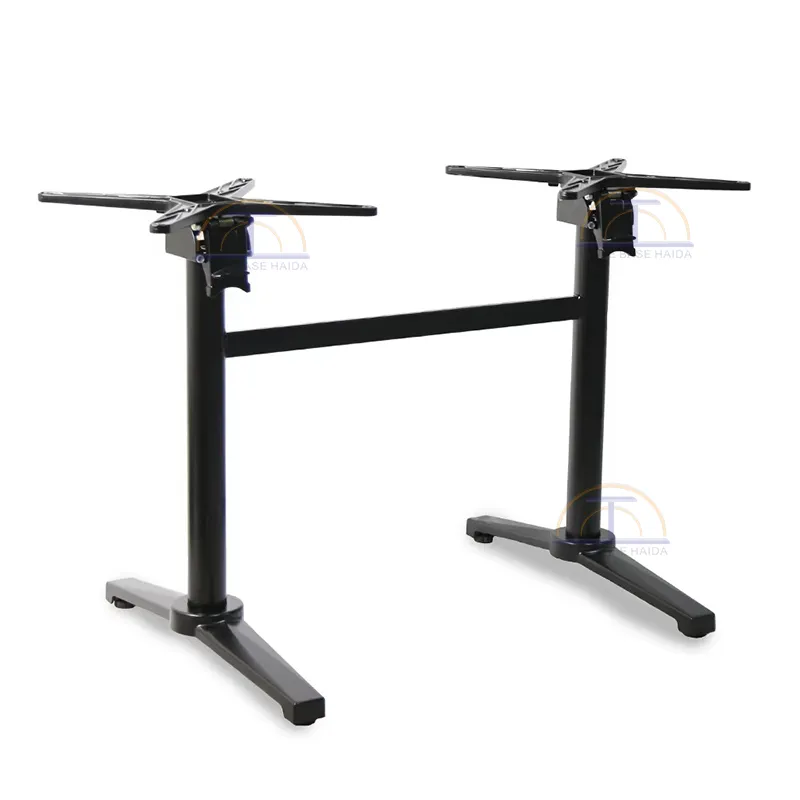
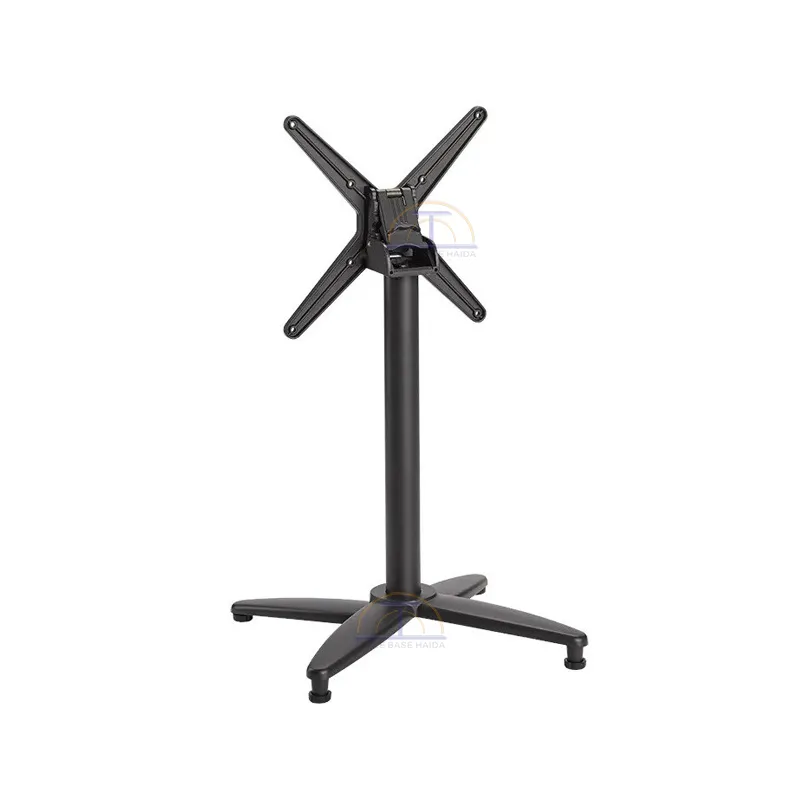
For cafes and patio operators who need to clear furniture regularly, the HD-J152 Lightweight Foldable Aluminum Base offers a folding format and lower handling weight. The HD-J153 Industrial Folding Aluminum X-Base is another option when buyers also prefer an open industrial X-shaped profile.
Compact Storage: Folding Plus Nesting
If storage floor area is limited, consider the HD-JN02 Stackable Folding Aluminum Table Base. Its folding top and stackable cross-base frame are designed for closer nesting when multiple tables are cleared after service. Confirm the assembled tabletop, folded clearance and practical storage arrangement with a sample.
Classic Bistro Appearance With More Base Mass
For a traditional bistro concept, the HD-J245 Foldable 3-Leg Cast Iron Claw Base combines an ornamental three-leg form, a powder-coated cast iron structure and a folding top. It may be worth reviewing where a heavier base is desired, but outdoor coating quality, stability and handling still need project-specific confirmation.
Mixed Cafe and Bar Use: Actual Height Adjustment
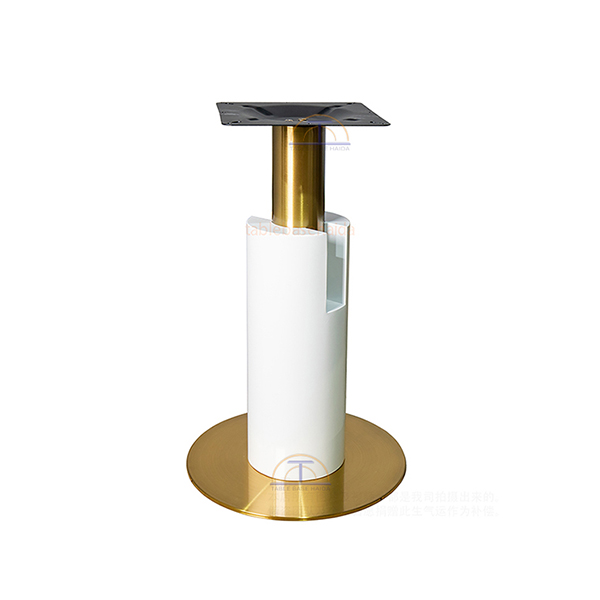
When a venue truly needs adjustable table height rather than separate fixed-height versions, compare the HD-J278 Adjustable Aluminum Lift Table Leg. Its product page describes an adjustable range of 700–1090 mm. Verify the locking mechanism, tabletop fit and stability at the intended working heights before ordering.
6. Specify the Tabletop and Mounting System Together
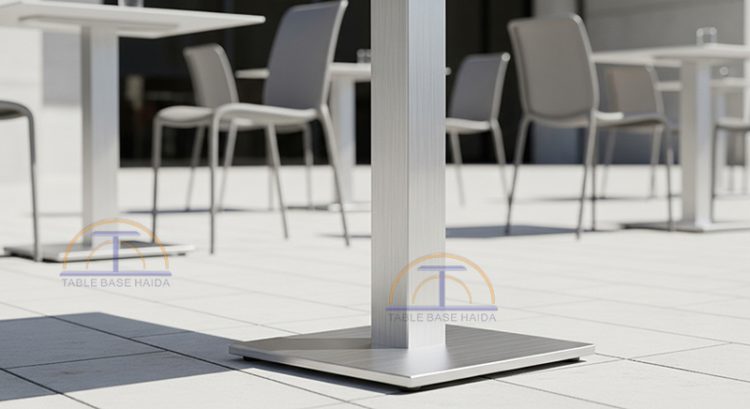
A base cannot be selected safely from the base catalogue alone. The tabletop changes the total mass, center of gravity, wind area, mounting loads and daily handling. Send the shape, dimensions, thickness, material and approximate weight of the planned top with every base request.
For outdoor-oriented projects, a suitable HPL top can be considered. Haida lists the Durable Weatherproof Round HPL Patio Table Top and other styles in its Table Top Series. Confirm that the exact top specification is intended for the project exposure; not every decorative laminate or stone-look surface should be treated as interchangeable.
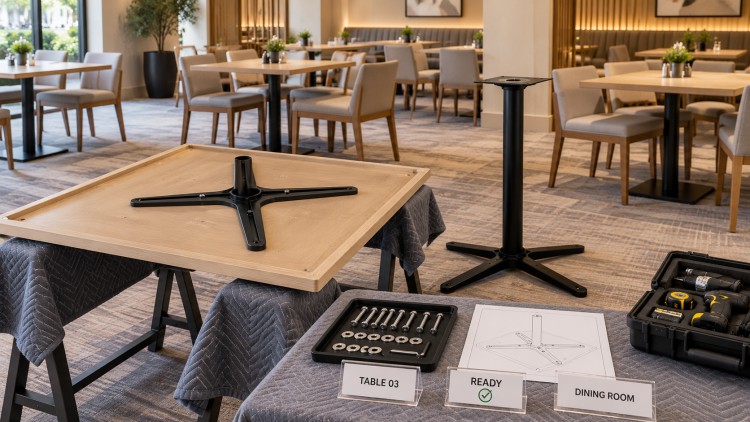
Mounting plate size, hole pattern, inserts and fasteners are also part of compatibility. Use the Table Base Mounting Plate & Hole Pattern Guide when the tabletop and base come from different suppliers or require OEM drilling patterns.
7. Do Not Ignore Floors, Glides and Maintenance
Outdoor paving is rarely perfect. Drainage slopes, tile joints and surface irregularities can create rocking even when the base itself is straight. Ask whether compatible adjustable leveling glides are available and whether their materials suit the exposure environment.
Maintenance should cover more than surface wiping. Confirm how to clean the coating, inspect exposed hardware, identify damage, touch up approved finishes if needed, and obtain replacement glides or screws for long-term operation.
For folding and stackable models, check hinge wear and any contact points that could scratch the finish during repeated storage. A convenient folding design still needs clear operating and maintenance instructions.
8. Match the Base to Common Commercial Outdoor Scenarios
The following scenarios are shortlisting examples, not guaranteed approvals. Final product suitability depends on the actual tabletop, base footprint, environment, floor and approved sample.
|
Project scenario |
Starting point |
What to verify |
| Sidewalk cafe with daily rearrangement | Lightweight aluminum folding base | Handling weight, folded size, tabletop match |
| Seasonal patio with limited storage | Folding and stackable/nesting base | Storage density, contact wear, locking |
| Traditional bistro dining | Coated cast iron with suitable finish | Finish protection, weight, floor and guest clearance |
| Coastal hotel terrace | Exposure-specific metal and finish specification | Chlorides, joints, hardware, maintenance |
| Exposed rooftop or windy dining | Complete table stability assessment | Wind, footprint, top size, height, site controls |
9. Approve the Sample and Inspect the Bulk Order
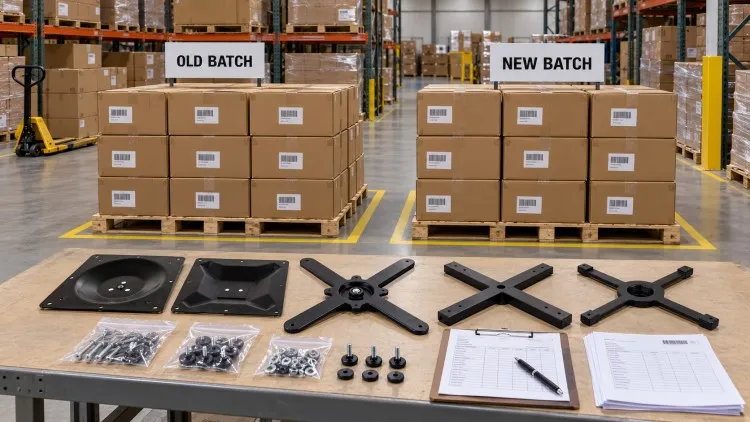
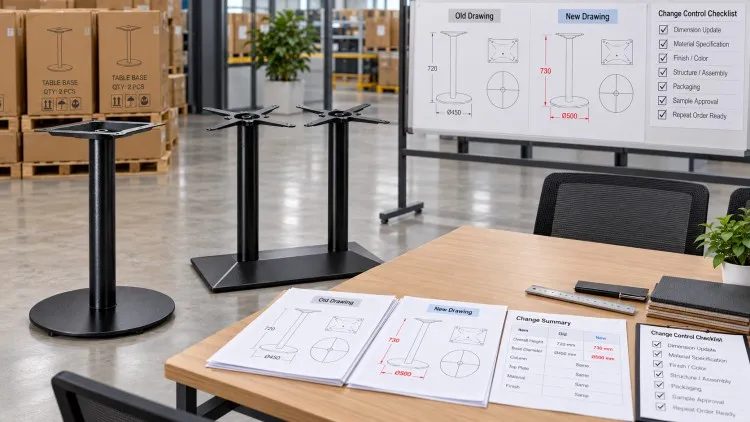
A quotation photograph and a well-made sample are not enough for repeated commercial orders. Buyers should approve the full table configuration and document material, base dimensions, height, top plate, hardware, finish, assembly and packing before mass production.
The Commercial Table Base Sample Approval Checklist can establish a consistent production reference. Before shipment, use the Commercial Table Base Pre-Shipment Inspection Checklist to check whether the bulk goods, hardware and packing match the approved version.
10. Send a Complete RFQ Before Comparing Prices
A fair quotation comparison starts when every supplier receives the same information. For outdoor bases, a model number and quantity alone rarely explain enough about the project.
- Project location and actual outdoor exposure
- Venue type and planned daily table movement
- Tabletop shape, size, material, thickness and approximate weight
- Required base height and preferred structure
- Base material or acceptable alternatives
- Finish, color reference and any required tests
- Footprint, top plate, mounting and hardware requirements
- Folding, stacking or adjustable-height needs
- Order quantity, packing, target market and shipment schedule
- Sample approval and inspection requirements
Compare the total table solution, not just the metal base price. Freight, replacement parts, finish consistency, installation compatibility and handling costs all affect the real purchasing decision.
11. Common Outdoor Table Base Buying Mistakes
- Choosing by material name without checking the actual outdoor exposure
- Assuming heavy automatically means wind-stable
- Using a compact base below a large or heavy tabletop without a complete-table review
- Treating a generic “rust-proof” label as a measurable finish specification
- Ignoring folding clearances, stack contact points and storage space
- Approving the base but not its mounting plate, glides and fasteners
12. Final Buying Recommendation
For outdoor dining, start with the site and complete tabletop specification. Then select the material and structure according to corrosion exposure, handling frequency, storage requirements and stability needs. Use the supplier sample and documented specification to confirm the final combination.
A compact sidewalk cafe may favor a lightweight folding aluminum base. A seasonal terrace may benefit from a nesting design. A decorative bistro may prefer coated cast iron. An exposed rooftop or coastal venue needs additional project-specific review rather than a universal product recommendation.
13. Frequently Asked Questions
What is the best material for an outdoor restaurant table base?
There is no universal winner. Aluminum is practical for frequently moved layouts, stainless steel can suit projects prioritizing a clean metal finish and corrosion resistance, and coated cast iron offers greater base mass. The actual site and full table configuration decide the right choice.
Is aluminum suitable for windy outdoor patios?
It can be suitable in some projects, but low weight means footprint and wind exposure need careful review. Do not approve a lightweight base for an exposed location without checking the assembled table and site conditions.
Is 304 stainless steel always enough for coastal outdoor dining?
No. Chloride exposure, crevices, surface condition and maintenance affect performance. Grade 316 generally provides better resistance to chloride-related pitting, but material selection still needs a site-specific review.
Are folding and stackable table bases the same?
Not necessarily. A folding mechanism changes the tabletop or base configuration for handling and storage. A stackable or nesting design also allows multiple units to be arranged together efficiently. Buyers should confirm the actual storage arrangement.
What tabletop information is needed before selecting an outdoor base?
Provide the shape, dimensions, material, thickness, approximate weight, mounting method and expected outdoor exposure. These details affect footprint, stability and the fixing system.
How can buyers reduce wobble on uneven patios?
Review floor slope and joints, confirm that leveling glides are suitable, and test the complete assembled table. Loose fasteners or poor tabletop-to-base mounting can also create perceived wobble.
What should commercial buyers approve before a bulk order?
Approve the model, material, base footprint, height, top plate, mounting holes, hardware, finish reference, any folding function and packing. Use an approved sample and check the production batch before shipping.
Request a Quote for Outdoor Table Bases
Planning an outdoor restaurant, cafe or hotel project? Send your tabletop size and weight, venue exposure, preferred base material and structure, quantity, finish and storage needs. Haida can help review suitable table base options and prepare a project-specific quotation.