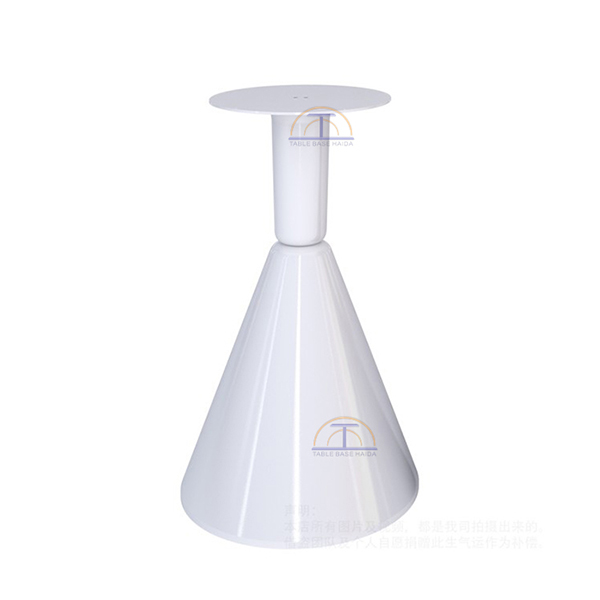
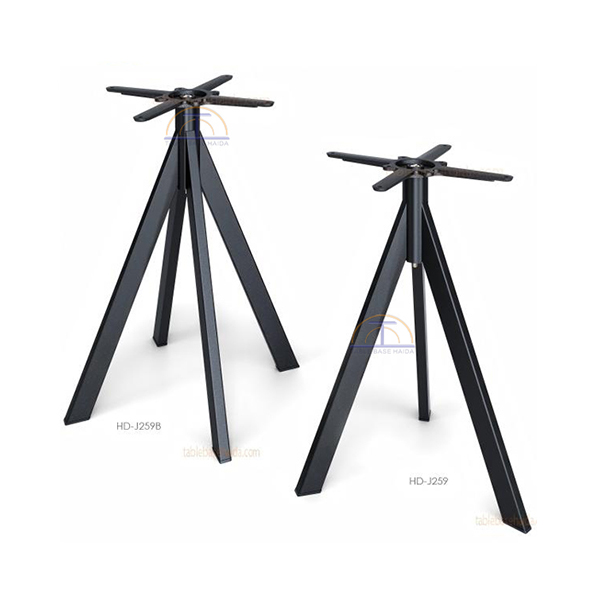
For restaurant groups, furniture dealers, importers, hospitality projects, and other B2B buyers, choosing a commercial table base supplier is not only a matter of comparing unit prices. The supplier model can influence specification accuracy, customization speed, quality-control visibility, packing, spare-parts support, and the consistency of future reorders.
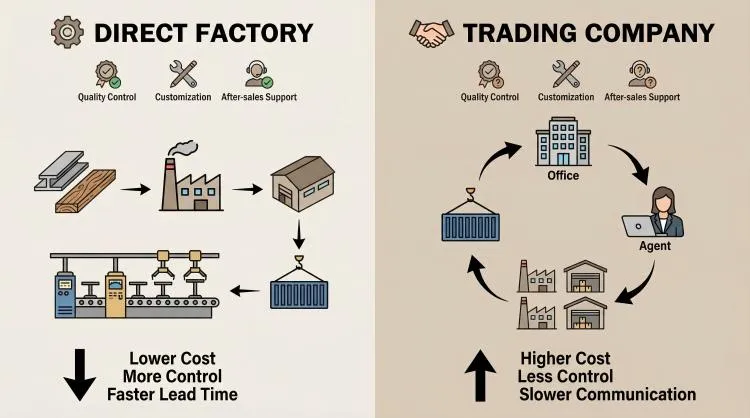
A direct factory and a trading company can both be useful. A manufacturer is often a better fit when the order requires custom dimensions, repeatable finishes, stable SKUs, project documentation, or long-term replenishment. A trading company can be practical when a buyer needs smaller quantities across several unrelated categories, supplier consolidation, or a single commercial contact for products made by different factories.
The useful question is therefore not, ‘Is a factory always better than a trading company?’ It is: ‘Which supplier model gives this project the right balance of production control, sourcing flexibility, total cost, and long-term support?’
1. What Is the Real Difference Between a Factory and a Trading Company?
A direct manufacturer produces the table bases itself or controls the core manufacturing process within its own production system. For metal table bases, that may include cutting, drilling, welding, casting, grinding, polishing, powder coating, assembly, inspection, packing, and loading.
A trading company usually purchases from one or more factories and manages commercial communication, supplier coordination, consolidation, documentation, export handling, or product sourcing on behalf of the buyer.
The key difference is the distance between the buyer’s approved specification and the production line. When an order requires changes to base dimensions, mounting plates, hole patterns, heights, finishes, hardware, or packing, every additional communication layer can affect how quickly and accurately those changes reach production.
This does not make one business model automatically better. It means buyers should evaluate the supplier model against the complexity of the order.
2. Factory vs Trading Company: Side-by-Side Comparison for B2B Buyers
| Buying Factor | Direct Factory | Trading Company |
| Production visibility | Closer access to manufacturing processes and production scheduling. | Depends on how transparent and stable the partner-factory network is. |
| Customization | Direct discussion of dimensions, structure, mounting plate, finish, hardware, and packing. | Can coordinate customization, but specifications may pass through an additional communication layer. |
| Quality control | Factory QC can be linked directly to drawings, samples, and production batches. | QC quality depends on the trader’s supplier management and inspection system. |
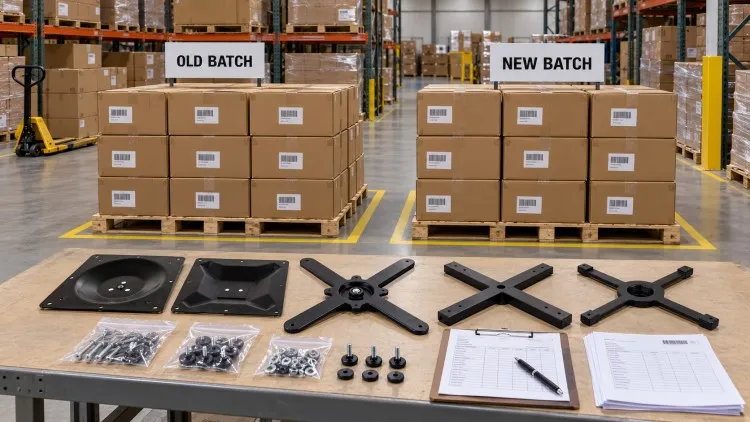
| Batch consistency | Easier to keep one production source and one approved standard for repeat SKUs. | Consistency may vary if production is moved between factories. |
| Product range | Usually strongest within the manufacturer’s own categories and processes. | Often stronger when the buyer needs many unrelated product categories. |
| Small mixed orders | May be constrained by production MOQ or model-level MOQ. | Can sometimes consolidate smaller quantities from different suppliers. |
| Repeat orders | Useful for long-term SKUs, replacement parts, and specification traceability. | Works well if the trader keeps the same factory and records the approved specification. |
| Cost structure | Fewer sourcing layers, but the lowest unit price is not guaranteed. | Price may include sourcing, coordination, consolidation, and service margin. |
| Best fit | Bulk orders, OEM, projects, chain rollouts, repeat SKUs, customized table bases. | Small mixed orders, multi-category sourcing, temporary purchasing, consolidation. |
The comparison should be used as a screening tool, not as a rule. A capable trading company can provide disciplined sourcing and inspection, while a poorly managed factory can still create quality, communication, or delivery problems.
3. When Does Buying Directly From a Table Base Factory Make More Sense?
Direct factory sourcing becomes more valuable when the table base is an important specification item rather than a generic commodity. This is common in commercial furniture programs where the same models must be repeated across stores, projects, or future replenishment orders.
- Regular wholesale replenishment or dealer stock programs
- Restaurant chain rollouts with standardized table sizes and finishes
- Hotel, hospitality, and contract furniture projects
- OEM or private-label table base programs
- Custom base footprints, columns, heights, or mounting plates
- Special powder-coat, brushed, polished, or decorative finishes
- Mixed dining-height and bar-height versions of the same model
- Projects that require pre-production samples or finish samples
- Orders that need traceable spare parts and repeat-order consistency
In these situations, the buyer usually needs the approved specification to remain consistent from RFQ to sample, mass production, inspection, packing, shipment, and future reorders. A shorter path between the buyer and production team can make revision control easier.
4. When Can a Trading Company Be a Practical Choice?
A trading company can be a good sourcing partner when coordination across several suppliers is more important than direct control of one manufacturing process. For example, a buyer may need chairs, tabletops, table bases, upholstered seating, accessories, and decorative items in relatively small quantities.
- The order combines several unrelated furniture categories
- Individual quantities are below the MOQ of each factory
- The buyer needs mixed-supplier consolidation into one shipment
- The purchasing team prefers one commercial contact
- The order is temporary and unlikely to become a repeat SKU program
- The trader provides local market knowledge, inspection, or documentation support that the buyer values
The critical issue is transparency. Buyers should know who actually manufactures the table base, whether the same factory will be used for future orders, and how the trading company controls samples, drawings, inspection, and production changes.
5. How to Verify Whether a Supplier Is Really a Factory
The phrase “factory direct” on a website or marketplace profile does not by itself prove production capability. Buyers should verify the manufacturing system before committing to a large or customized order.
Ask Which Processes Are Done In-House
Ask specifically about laser cutting, tube cutting, drilling, welding, casting, grinding, polishing, powder coating, brushing, assembly, packing, and loading. A factory does not need to perform every process internally, but it should clearly explain which processes it controls and which are subcontracted.
Review Equipment That Matches the Product
The equipment shown should be relevant to the products being sold. A supplier offering welded steel bases should be able to explain its cutting, welding, grinding, finishing, and inspection workflow.
Request Current Production Evidence
Recent production videos, batch photos, inspection records, or a live video call can be more useful than a polished company brochure. Ask to see raw materials, components, welding, surface finishing, assembly, inspection, packing, and finished stock.
Check Model and Revision Traceability
For repeat orders, the supplier should be able to connect a model or buyer SKU to the correct height, finish, mounting plate, hole pattern, hardware set, and packing version.
6. Compare Total Purchasing Cost, Not Only Unit Price
The lowest quoted unit price is not always the lowest-cost sourcing option. Commercial buyers should compare the complete cost of receiving a usable, installable, repeatable product.
A practical total-cost review can include product price, sample cost, tooling, inspection, packing, inland transport, ocean or air freight, rework, replacements, installation problems, and delays.
A table base that is slightly cheaper can become more expensive if the finish does not match the approved sample, mounting holes do not match the tabletop, hardware is missing, cartons fail during transport, or replacement components cannot be identified after delivery.
For a structured project-level comparison, see Contract Furniture Table Bases: Project Procurement Guide, which covers RFQ preparation, application zoning, samples, packing, and project coordination.
7. Customization Is Where Supplier Structure Becomes Visible
Many suppliers advertise OEM capability, but the useful question is what can actually be changed, how the change is documented, and how the approved version is transferred into production.
- Base footprint or diameter
- Column shape or tube size
- Overall dining, counter, or bar height
- Mounting plate size and hole pattern
- Powder-coat color and texture
- Brushed or polished stainless-steel finish
- Hardware and leveling glides
- Carton marks, barcode labels, and private-label packaging
- KD packing configuration
- Mixed-model or project-specific packing rules
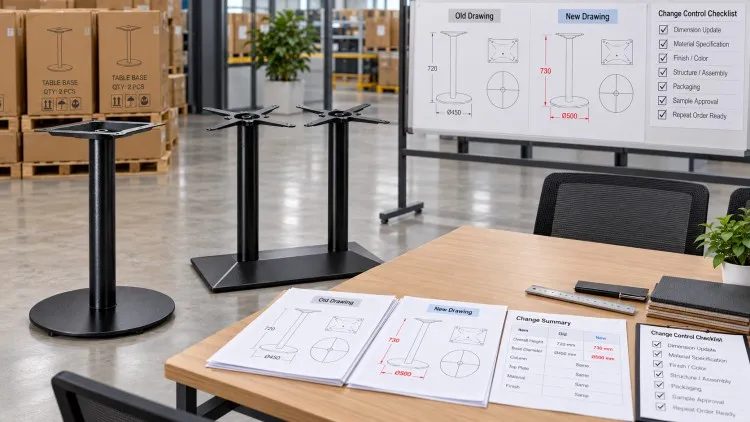
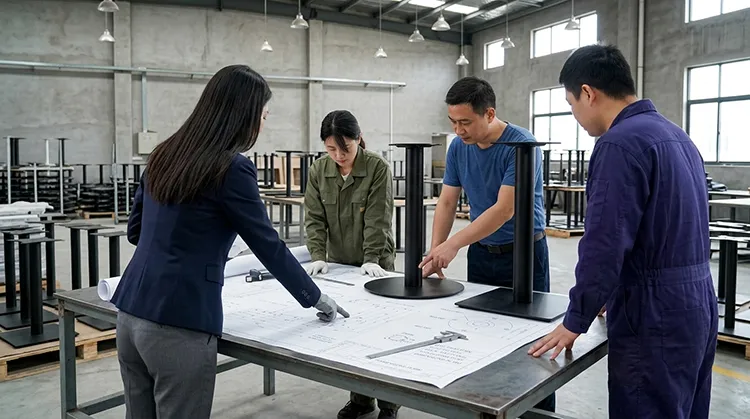
For complex OEM orders, ask for a written specification sheet or drawing revision rather than relying only on chat messages. The document should become the shared reference for sample approval, production, and inspection.
8. Sample-to-Production Consistency Matters More Than a Good Sample
A supplier can make one good sample. The more important test is whether the same standard can be reproduced across the production batch.
Before mass production, the approved sample should define the items that cannot drift without buyer approval:
- Base footprint and overall height
- Column dimensions and alignment
- Top plate dimensions and hole positions
- Material and finish
- Color and gloss or texture level
- Weld and casting appearance
- Hardware, glides, and accessory bags
- Packing method, carton marks, and labels
A structured Commercial Table Base Sample Approval Checklist can be used to convert the approved sample into a production reference rather than treating it as a sales sample.
9. Compare Quality-Control Visibility Before the PO
Commercial table bases combine dimensions, welding, surface finish, mounting compatibility, hardware, and packing. A defect in any one of these areas can create installation problems or customer complaints after the goods arrive.
Dimensions
Verify overall height, floor-base dimensions, column position, top plate dimensions, and important tolerances.
Mounting Compatibility
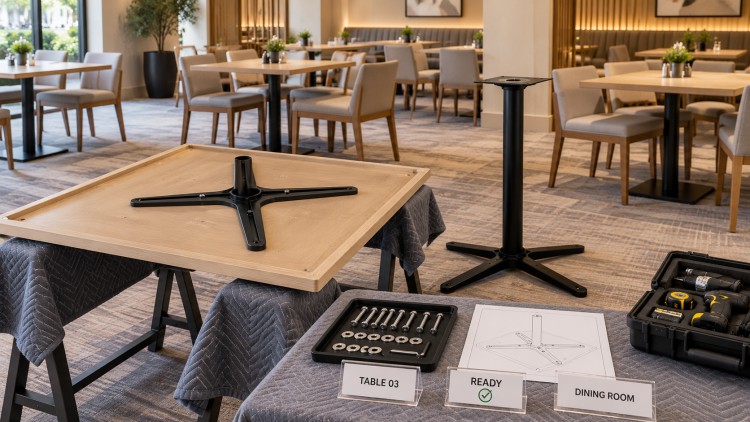
Confirm top plate size and hole pattern against the intended tabletop, inserts, or screw layout.
Structure and Welding
Check weld position, penetration or continuity where applicable, alignment, and visible finishing on fabricated steel structures.
Surface Finish
Compare powder coating, brushing, polishing, color, texture, and gloss with the approved reference under consistent lighting.
Hardware
Confirm bolts, screws, washers, nuts, glides, tools, and hardware bags by model.
Packing
Verify individual protection, separation between metal parts, carton quantity, labels, and carton marks.
The final production check should reference the approved sample, drawing, PO, finish standard, and packing version. The Commercial Table Base Pre-Shipment Inspection Checklist provides a useful framework for this stage.
10. Material and Finish Control Can Expose Weak Supplier Management
Commercial table bases are commonly produced in cast iron, aluminum, steel, and stainless steel. The correct material depends on the application, tabletop, movement requirements, cleaning environment, target finish, and project budget.
A supplier comparison should therefore ask not only “What material do you offer?” but also “How do you control the exact material and finish that was approved?”
- Cast iron for stable indoor commercial pedestal, X-base, square, and twin-column designs
- Aluminum for lighter-weight patio, folding, stackable, and flexible seating layouts
- Steel for welded structures, rectangular bases, frames, and modern powder-coated designs
- Stainless steel for brushed, polished, premium, and food-service-oriented commercial interiors
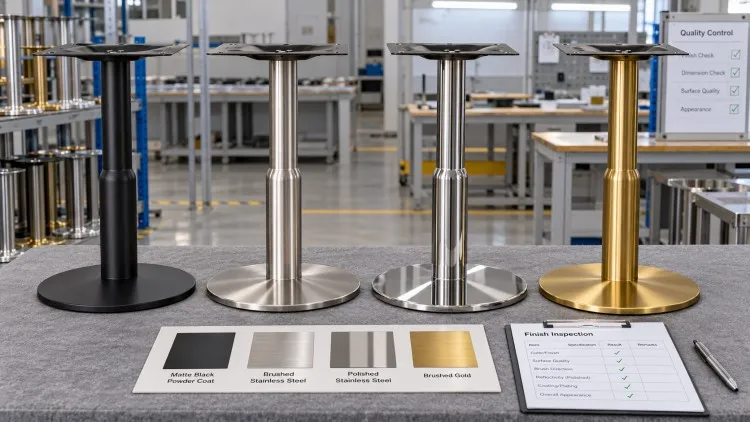
For repeat programs, finish references should be recorded by model or SKU. Black powder coat, brushed stainless steel, polished metal, gold finishes, and custom colors can all vary if the production reference is not controlled between batches.
11. Packing Is Part of Supplier Capability, Not an Afterthought
Table bases are rigid, relatively heavy products with painted, brushed, polished, or plated surfaces that can be damaged by metal-to-metal contact or poor carton protection. Packing should therefore be reviewed as part of the product specification.
- KD or assembled packing
- Sets per carton
- Individual wrapping and surface protection
- Separation between metal components
- Hardware bags and installation tools
- Model labels and buyer SKU labels
- Private-label carton marks
- Barcode requirements
- Pallet or container-loading requirements
- Replacement-part identification
Receiving inspection should then verify whether the shipment arrived with the correct quantity, model, carton condition, finish condition, and hardware after transportation.
For the receiving stage, link the factory inspection record to the Imported Table Base Warehouse Receiving Inspection Checklist so damage and shortages can be separated from production defects.
12. Lead Time and Production Planning: Ask What the Quote Does Not Show
Quoted lead time can hide important differences between suppliers. Buyers should understand whether the time starts after deposit, drawing approval, finish approval, or sample confirmation, and whether the order depends on outsourced components or finishing.
- Sample lead time versus mass-production lead time
- Time required for custom tooling or special finishes
- Production capacity during peak seasons
- Whether mixed models can run in the same order
- How late drawing or finish changes affect the schedule
- When packing materials and carton artwork must be approved
- How shipment dates are confirmed before container booking
For chain, dealer, and contract-furniture programs, a reliable production schedule is often more valuable than a small unit-price difference because late tables can delay installation, store opening, or project handover.
13. Repeat Orders, Spare Parts, and After-Sales Support Should Be Planned Before the First PO
Supplier evaluation should include what happens after the first container arrives. Dealers, importers, and restaurant groups often need to reorder the same SKU months later or replace small components without purchasing complete bases.
- Can the same model specification be reproduced later?
- Is the finish reference recorded by model or buyer SKU?
- Can mounting plates and hole patterns remain consistent?
- Can hardware kits be reordered separately?
- Are glides and leveling feet traceable by model?
- Can damaged components be replaced without buying a complete base?
- Can the supplier identify which batch or revision a replacement belongs to?
A basic Table Base Spare Parts Kits for Dealers and Importers plan can reduce urgent air shipments and make after-sales service easier for the dealer.
14. Which Supplier Model Fits Different Buying Situations?
| Buying Situation | What Usually Matters Most | Supplier Model to Evaluate First |
| Restaurant chain rollout | Repeatable SKUs, finish consistency, spare parts, phased replenishment | Direct factory is often efficient if the product range fits the program |
| Hotel / contract project | Drawings, BOQ coordination, samples, finishes, delivery phases | Direct factory or a strong project supplier with documented production control |
| Furniture dealer / wholesaler | Stable repeat SKUs, mixed models, carton identification, after-sales parts | Factory for core SKUs; trader can help with wider mixed categories |
| Small mixed-category order | Low quantities across chairs, tables, accessories, and décor | Trading company may simplify consolidation |
| OEM / private label | Custom dimensions, finish, labels, cartons, repeatability | Direct factory is usually easier to audit and revise |
| One-time sourcing test | Speed, small quantity, market testing | Either model can work; compare MOQ, sample policy, and total landed cost |
15. Send the Same RFQ to Every Supplier
Supplier comparison becomes unreliable when each company is quoting a different assumption. Send the same RFQ to every shortlisted supplier so the quotations can be compared on the same technical and commercial basis.
| RFQ Item | Information to Send |
| Application | Restaurant, hotel, cafe, office, outdoor, banquet, dealer stock, etc. |
| Tabletop | Shape, dimensions, thickness, material, and approximate weight |
| Quantity | Per model, sample quantity, trial order, and expected reorder volume |
| Base | Preferred material and structure: pedestal, square, X-base, twin-column, folding, etc. |
| Height | Dining, counter, bar, or custom |
| Finish | Powder coat, brushed, polished, texture, color reference, or RAL code |
| Mounting | Top plate size, hole pattern, insert layout, or drawing |
| Packing | KD or assembled, sets per carton, label, carton mark, barcode, pallet needs |
| Sample | Standard sample, finish sample, custom sample, or golden sample |
| Delivery | Target shipment date, destination, shipping terms, and required documents |
For a complete template, use the Commercial Table Base RFQ Checklist before requesting quotations.
16. Supplier Audit Checklist Before You Place the PO
- Who actually manufactures the table base?
- Which processes are controlled in-house and which are subcontracted?
- Will the same production source make the sample and bulk order?
- How are drawings and specification revisions controlled?
- How are finish and color references approved and recorded?
- What quality-control checkpoints are used during production?
- Can pre-shipment inspection photos, videos, or records be provided?
- How are hardware, spare parts, and model-specific components controlled?
- Can the same SKU be reproduced for future orders?
- How is export packing defined and approved?
- Can cartons and products be traced by model, SKU, or batch?
- Who handles corrective action if a problem is found after delivery?
A supplier that cannot answer these questions clearly before the PO is likely to give the buyer less control once production begins.
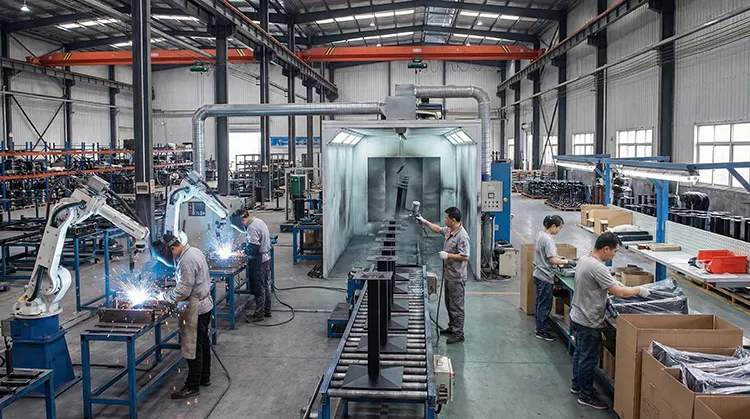
17. How Haida Fits a Factory-Direct Table Base Sourcing Program
Haida Furniture is a Foshan-based commercial table base manufacturer established in 2008. Its current production information lists laser cutting, automated welding, powder-coating lines, assembly, and quality-control processes, while the product range covers cast iron, aluminum, steel, and stainless steel table bases.
For buyers evaluating Haida, the most useful starting point is the actual table configuration rather than only a model number. Provide the tabletop dimensions, material and approximate weight, quantity, application, preferred base material, height, finish, mounting requirements, packing, and target delivery schedule.
That information allows the final model and specification to be checked against the intended commercial application before sample approval or bulk production.
Relevant product categories: Cast Iron Table Bases | Aluminum Table Bases | Steel Table Bases | Stainless Steel Table Bases
18. Conclusion: Choose the Supplier Model That Matches the Order
Choosing between a direct factory and a trading company should not be reduced to a simple question of which one offers the lowest price. A trading company can be useful for small mixed-category orders, consolidation, and broader sourcing. A direct manufacturer can be especially useful when the order depends on customized specifications, sample-to-batch consistency, documented QC, repeatable finishes, spare parts, and long-term SKU control.
For commercial table base buyers, the strongest sourcing decision is based on verified production capability, clear specifications, an approved sample, practical inspection, protective packing, and repeat-order support.
Before comparing quotations, prepare the tabletop dimensions and weight, required base structure, material, height, finish, quantity, packing requirements, sample needs, and target delivery date. When every supplier receives the same information, price and capability become much easier to compare.
FAQ
Is buying directly from a table base factory always cheaper?
No. Direct sourcing can reduce intermediary layers, but the lowest total cost depends on MOQ, customization, packing, inspection, freight, consolidation, replacement risk, and after-sales requirements. A trading company may be economical for small or multi-category orders.
How can I tell whether a table base supplier is a real manufacturer?
Ask which production processes are controlled in-house, review relevant equipment, request current production evidence, confirm how samples and drawings are transferred into production, and check whether the supplier can trace models, batches, finishes, and packing versions.
When should I choose a direct table base manufacturer?
Direct manufacturing is particularly relevant for bulk orders, repeat SKUs, restaurant chains, hospitality projects, OEM programs, custom finishes, special dimensions, and orders that require long-term replenishment or spare-parts support.
When can a trading company be useful?
Trading companies can be practical when the buyer needs small quantities from several categories, supplier consolidation, local sourcing support, or one commercial contact coordinating products from multiple factories.
What should I compare besides unit price?
Compare material, dimensions, sample policy, finish consistency, mounting compatibility, QC process, packing, lead time, accessories, documentation, replacement handling, and repeat-order capability.
Should I use the same sample factory for mass production?
Ideally, the buyer should know whether the approved sample and the bulk order will come from the same production source and process. If the source changes, the critical specifications and finish reference should be re-approved.
What information should I send when requesting a table base quote?
Provide the application, tabletop size and material, approximate tabletop weight, quantity, preferred base structure and material, height, finish, mounting requirements, packing, sample needs, delivery date, and destination.