1. Why Replacing a Table Base Is Different From Buying a New Table
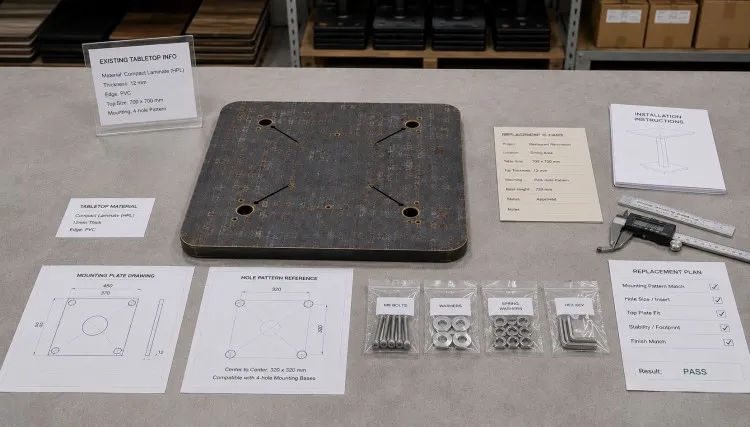
Replacing a restaurant table base looks simple until the buyer tries to reuse the existing tabletop.
A new base may have the correct appearance and height but still fail to match the existing mounting plate, hole pattern, threaded inserts, tabletop weight or required floor footprint.
For replacement orders, the buyer should therefore treat the existing tabletop as the starting specification.
The goal is not simply to find a base that looks similar. The goal is to confirm whether the new base can connect safely and practically to the existing tabletop while maintaining the required finished table configuration.
2. Decide Whether the Base Needs Repair or Complete Replacement
Before searching for a new table base, determine whether the problem actually requires complete replacement.
Some problems may be caused by missing hardware, damaged glides, loose fasteners or one replaceable component rather than the complete base structure.
If the problem involves a recent shipment, production defect or damaged batch, buyers can first use the Commercial Table Base Warranty Claim Checklist to determine whether the issue should be handled as a claim, repair or replacement request.
A complete base replacement is more likely when:
- The column or structural connection is damaged
- The existing base is no longer suitable for the tabletop
- The restaurant is changing dining or bar height
- The original model is discontinued
- The floor footprint needs to change
- The restaurant is standardizing several different old models
- The existing mounting structure cannot be repaired practically
Identifying the real problem first prevents unnecessary replacement costs.
3. Create a Replacement Table Record
Each replacement table should have a simple record before a new base is selected.
For a restaurant with several table types, use a replacement ID so photos, measurements and product recommendations do not become mixed.
Useful replacement information includes:
- Replacement ID
- Restaurant or location
- Existing tabletop size
- Tabletop material
- Tabletop thickness
- Approximate tabletop weight
- Existing base type
- Existing base height
- Existing mounting plate size
- Existing hole pattern
- Current finished table height
- Reason for replacement
This information becomes the reference for comparing new base options.
4. Inspect the Existing Tabletop Before Choosing the Base
Do not start by measuring only the old table base.
The tabletop itself determines many of the replacement requirements.
Check whether the top is wood, HPL, laminate, MDF, stone, sintered stone, glass or another material.
Then inspect its underside for mounting inserts, old screw holes, reinforcement plates, mounting blocks or other structural components.
The underside often provides more useful replacement information than the visible top surface.
5. Record the Tabletop Dimensions and Weight
The replacement base should be matched to the complete tabletop specification.
Record:
- Round, square, rectangular or custom shape
- Length and width
- Diameter for round tops
- Thickness
- Material
- Approximate weight
- Edge profile
- Existing reinforcement underneath
A 700 mm wood tabletop and a 700 mm stone tabletop should not automatically receive the same replacement base recommendation.
Tabletop weight, material and mounting structure all affect the final decision.
6. Take Clear Photos of the Tabletop Underside
Photos are especially important when the restaurant, dealer and table base supplier are in different countries.
A useful photo set should show:
- Complete underside of the tabletop
- Existing mounting plate
- All existing holes
- Threaded inserts
- Screw or bolt type
- Reinforcement blocks or frames
- Damaged areas
- Old table base before removal
- A ruler or tape measure visible beside critical dimensions
Photos should be connected to the same replacement ID as the measurement sheet.
7. Measure the Existing Mounting Plate
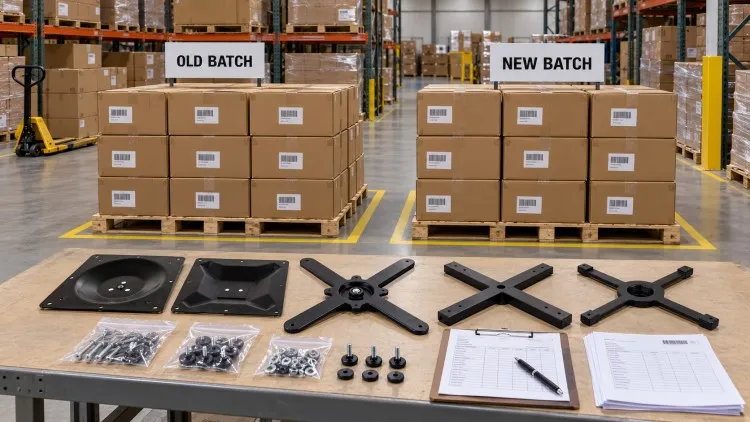
One of the most important replacement dimensions is the mounting plate between the column and tabletop.
Depending on the supplier, this component may also be described as a top plate, spider or mounting bracket.
Measure and record:
- Overall plate length
- Overall plate width
- Plate shape
- Number of fixing holes
- Hole positions
- Center-to-center distances
- Round holes or slots
- Approximate hole diameter
- Location relative to the tabletop centerline
Two bases can have the same column height while using completely different top plates.
8. Do Not Assume the New Hole Pattern Will Match
A common replacement mistake is assuming that commercial table base mounting holes are universal.
They are not necessarily interchangeable.
Commercial table base suppliers increasingly publish mounting-plate dimensions and compatible tabletop information because these details materially affect installation.
The replacement supplier should compare the new mounting plate drawing with the existing tabletop hole pattern before the order is approved.
9. Understand the Existing Inserts and Fasteners
The visible hole is only one part of the fixing system.
The buyer should also determine what is inside or below the tabletop.
Possible fixing methods include:
- Wood screws
- Machine screws with threaded inserts
- Bolts and embedded hardware
- Mounting blocks
- Reinforcement plate
- Manufacturer-specific fixing system
For stone, glass, sintered stone or other specialized tabletops, do not assume that new holes can simply be drilled on site.
The tabletop manufacturer, fabricator or qualified installer should confirm the permitted fixing method and whether new inserts, adapters or reinforcement are required.
10. Compare Existing Hole Patterns With the New Top Plate
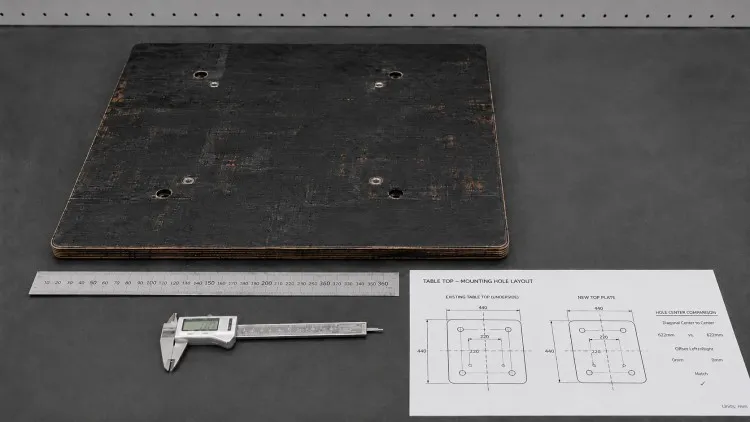
The replacement review should compare the old and new mounting systems side by side.
| Check Item | Existing Table | New Base |
| Top plate size | Record actual size | Confirm supplier drawing |
| Plate shape | Round / square / cross / other | Confirm |
| Number of holes | Count | Confirm |
| Hole spacing | Measure center-to-center | Compare drawing |
| Insert type | Record | Confirm compatibility |
| Fastener type | Record | Confirm required hardware |
| Center position | Measure | Confirm base alignment |
A mismatch does not automatically mean the replacement is impossible, but it should be resolved before bulk ordering.
11. Compare Different Replacement Base Structures
A replacement does not always need to copy the original base shape.
If the restaurant is refurbishing the space, the replacement process can also be used to improve footprint, appearance, height or tabletop compatibility.
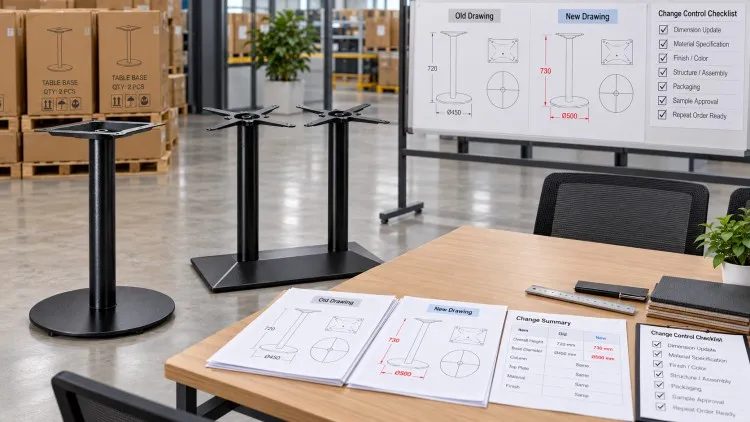
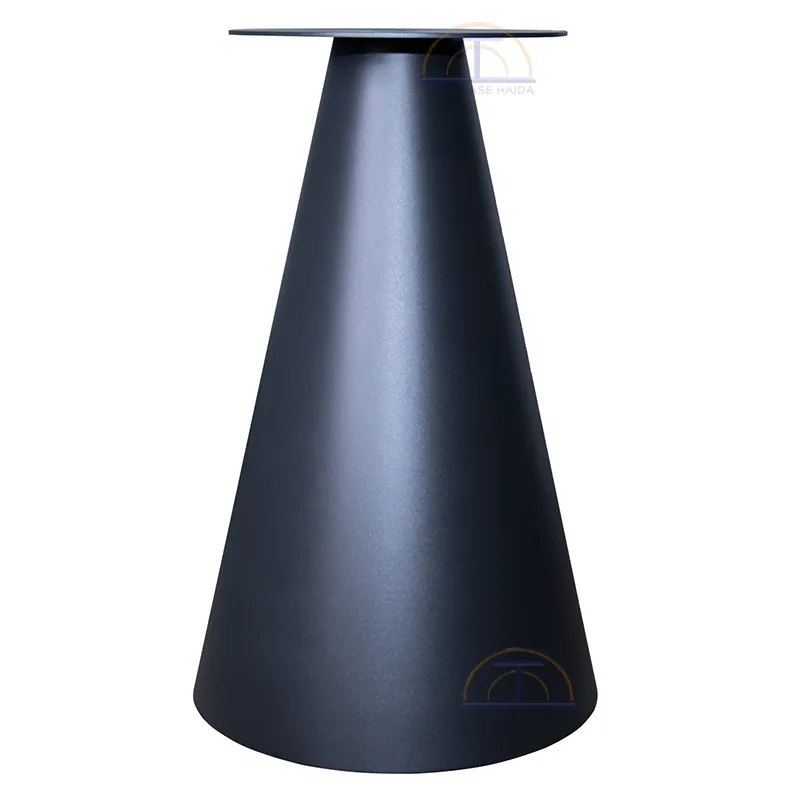
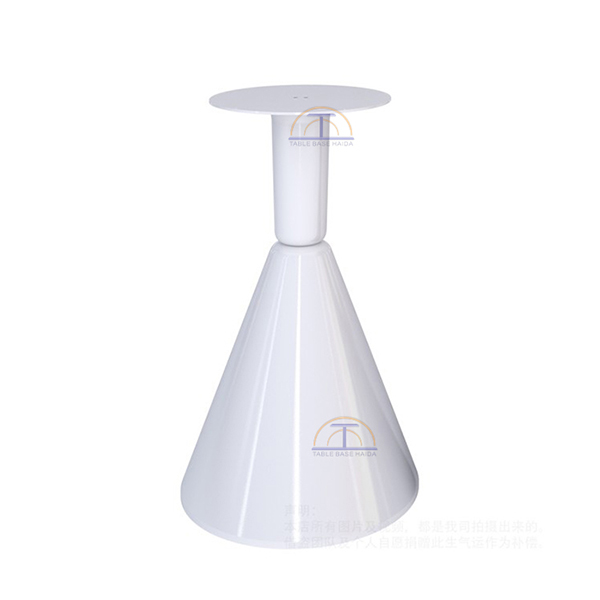
The Modern Cone Cast Iron Pedestal Table Base HD-JN07 provides 450 mm and 500 mm base options, 720 mm or 1080 mm heights and a 350 mm top plate. It illustrates why the new top plate must be checked against the existing tabletop even when the required table height appears suitable.
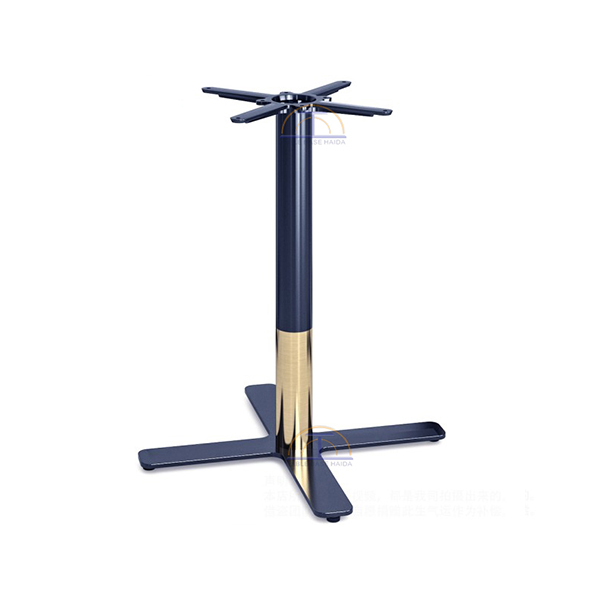
The Modern Minimalist Cross Iron Base HD-J249 uses a 640 mm base spread, 720 mm height and 300 mm or 450 mm top plate options. Its current page also lists tabletop guidance of 600 mm, 700 mm and 800 mm, making it a useful example of how top-plate size and floor footprint need to be reviewed together.
For longer rectangular tabletops, the Steel Parallel Double Column Table Base HD-JN01 provides a double-column structural direction.
The Vintage Stainless Steel Round Pedestal Base HD-J133 provides 500 mm or 600 mm base sizes, 720 mm or 1080 mm heights and a 450 mm top plate. It is another example of why replacement buyers should compare base footprint, height and mounting plate as separate dimensions.
These products are structural examples rather than universal replacements. Final compatibility should be confirmed from the actual existing tabletop.
12. Match the Finished Table Height
Replacing a base can change the finished table height even when the tabletop remains unchanged.
Record the existing finished height before removing the old base.
Then compare:
- New base height
- Tabletop thickness
- Any mounting blocks or spacers
- Foot or glide adjustment
- Required dining, counter or bar configuration
A dining-height replacement should not be approved simply because the supplier describes it as “standard dining height.”
The buyer should compare the actual finished configuration.
13. Check the New Floor Footprint
Replacement compatibility is not limited to the connection underneath the tabletop.
The new base also has to work with the restaurant floor plan.
Check:
- Base diameter or spread
- Distance to chair legs
- Guest foot and knee clearance
- Cleaning access
- Adjacent table spacing
- Booth or wall clearance
- Existing floor marks or fixed services
A larger base may improve one part of the table configuration while creating interference with chairs or circulation.
14. Review Long and Rectangular Tabletops Separately
A long tabletop should not automatically receive one central pedestal simply because the old table used one.
The buyer should record the tabletop length, material, weight, support positions and existing deflection or movement.
Long rectangular tops may require two bases, a twin-column structure or another support arrangement depending on the complete table configuration.
Longer or heavier tops should be reviewed separately from compact restaurant tops rather than applying one universal base rule.
15. Confirm Fasteners With the New Base
Do not assume the old screws or bolts should automatically be reused.
A different mounting plate may change the required hole location, fastener length, fastener type or washer arrangement.
The replacement specification should identify:
- Fastener type
- Diameter or thread specification
- Required length
- Washer or nut requirement
- Quantity per table
- Whether existing inserts will be reused
- Whether new hardware is included with the base
The installer should confirm that the selected fastener is appropriate for the actual tabletop substrate and fixing system.
16. Separate Small Parts Replacement From Complete Base Replacement
Sometimes the best replacement base is no new base at all.
If the structure is still usable and the problem is limited to glides, screws, bolts, washers or another replaceable component, a spare-parts repair may be faster and more economical.
The Table Base Spare Parts Kits for Dealers and Importers explains how dealers can organize frequently required hardware and replacement parts alongside commercial table base orders.
Before replacing the complete product, identify whether the damaged component is independently serviceable.
17. Test One Replacement Before Converting the Whole Restaurant
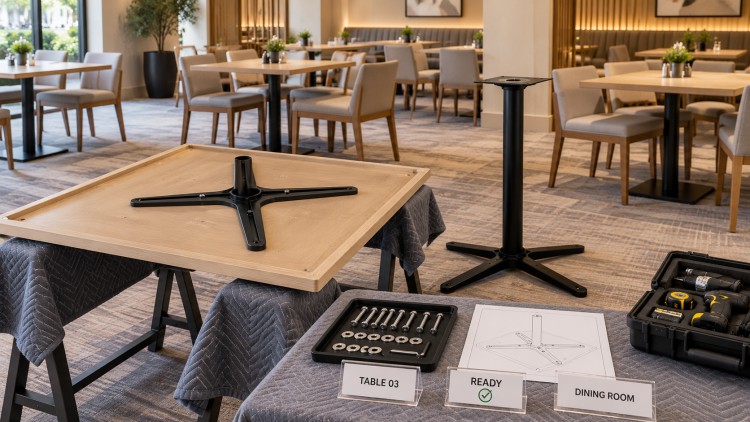
When many existing tabletops use the same old base, test one complete replacement first.
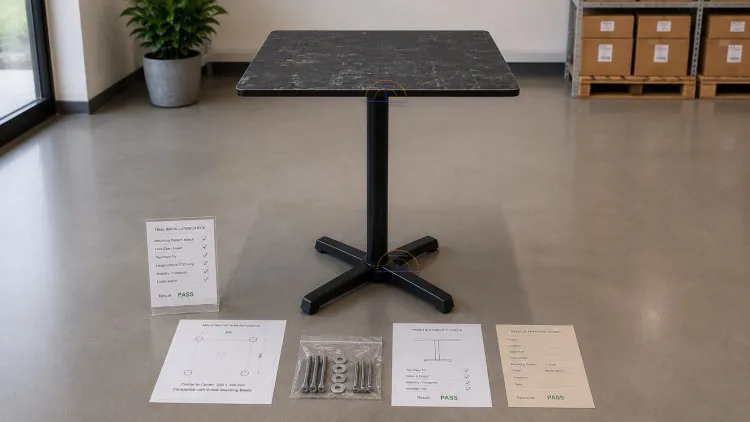
The trial installation should confirm:
- Mounting plate fit
- Hole pattern or approved alternative fixing method
- Finished table height
- Tabletop alignment
- Stability after assembly
- Chair and guest clearance
- Appearance
- Hardware completeness
- Installation time and practical difficulty
Only after the trial is approved should the buyer convert the full quantity.
18. Create a Replacement Order Specification
A replacement purchase order should identify more than the new model number.
The replacement specification should include:
| Field | Information |
| Replacement ID | Buyer reference |
| Existing tabletop | Size, material, thickness, weight |
| New base model | Approved supplier model |
| Base height | Confirmed height |
| Floor footprint | Base size or spread |
| Top plate | Size and drawing reference |
| Hole pattern | Confirmed / adapter / new fixing plan |
| Fasteners | Approved hardware specification |
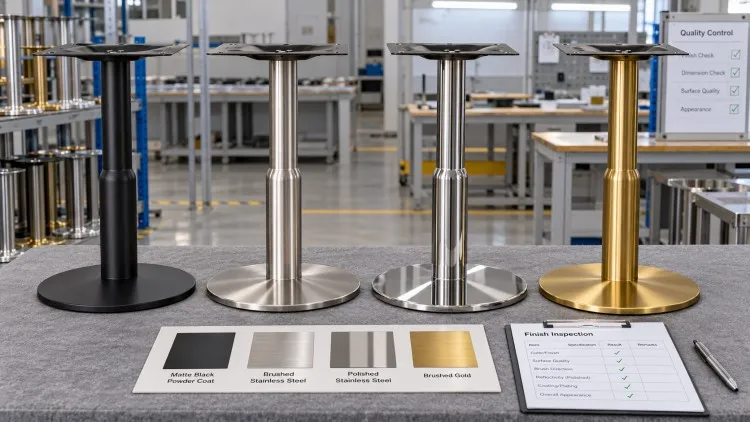
| Finish | Approved color and texture |
| Packing | Replacement-order packing |
| Quantity | Required replacement quantity |
| Sample status | Approved trial reference |
This record makes future replacement orders easier to repeat.
19. Prepare the Installation Handoff
A replacement shipment should arrive with enough information for the dealer or installer to understand what changed.
Useful handoff information can include:
- Product model
- Assembly drawing
- Top plate drawing
- Hardware list
- Approved mounting method
- Existing hole reuse instructions, if applicable
- New insert or adapter reference, if applicable
- Finished height target
- Trial installation photos
- Replacement ID or location reference
For floor anchors, special tabletop materials or non-standard fixing conditions, the qualified local installer should confirm the substrate, project drawings and applicable local requirements before installation.
20. Common Replacement Table Base Mistakes
Replacement problems usually come from assuming the new product is interchangeable with the old one.
Common mistakes include:
- Ordering from the tabletop size alone
- Not photographing the tabletop underside
- Ignoring the existing mounting plate
- Assuming hole patterns are universal
- Reusing old fasteners without checking
- Ignoring tabletop material
- Matching base height but not finished table height
- Selecting a larger footprint that interferes with chairs
- Using one pedestal for a long top without reviewing support
- Replacing complete bases when only small parts are damaged
- Ordering the full quantity without a trial installation
A replacement workflow should verify both tabletop connection and final restaurant operation.
21. How Haida Supports Replacement Table Base Orders
Haida offers cast iron, steel, stainless steel and aluminum commercial table base options, including different pedestal, cross-base and double-column structures. The current product range also provides different mounting plate sizes and dining or bar-height configurations depending on the model.
For replacement requests, buyers should send the existing tabletop size, material, thickness, underside photos, hole-pattern measurements, existing base height and required quantity.
To review compatibility, buyers can contact Haida for replacement table base support and include photos of both the existing tabletop underside and old base.
22. FAQ
Q1: Can I replace a restaurant table base without replacing the tabletop?
Often yes, but compatibility should be checked first. The tabletop material, size, weight, mounting plate, hole pattern, inserts and finished height all need to be reviewed.
Q2: Are table base mounting holes universal?
No. Hole number, spacing, plate size and fixing method can differ between models and suppliers.
Q3: What photos should I send when asking for a replacement base?
Send the complete tabletop, underside, old mounting plate, hole pattern, inserts, fasteners, old base and any damaged areas. Include a ruler or tape measure where dimensions need to be confirmed.
Q4: Can I drill new holes into the existing tabletop?
That depends on the tabletop material and construction. Wood-based tops, stone, glass, sintered stone and other materials require different fixing methods. The tabletop manufacturer, fabricator or qualified installer should confirm whether new holes or inserts are permitted.
Q5: Should I test one base before replacing all restaurant tables?
Yes. For repeat configurations, one trial installation can confirm the mounting plate, hole pattern, height, footprint, hardware, stability and installation process before the full quantity is ordered.
23. Conclusion
Replacing a commercial table base is not simply a matter of choosing another product with a similar appearance.
The existing tabletop should become the main reference for the replacement specification.
Buyers should record the tabletop material, dimensions, weight, underside structure, mounting plate, hole pattern, existing height, floor footprint and fasteners before selecting the new base.
When one replacement is tested before the complete rollout, restaurants and dealers can reduce installation surprises and create a repeatable specification for future replacements.