1. Why Contract Furniture Projects Need a Different Buying Process
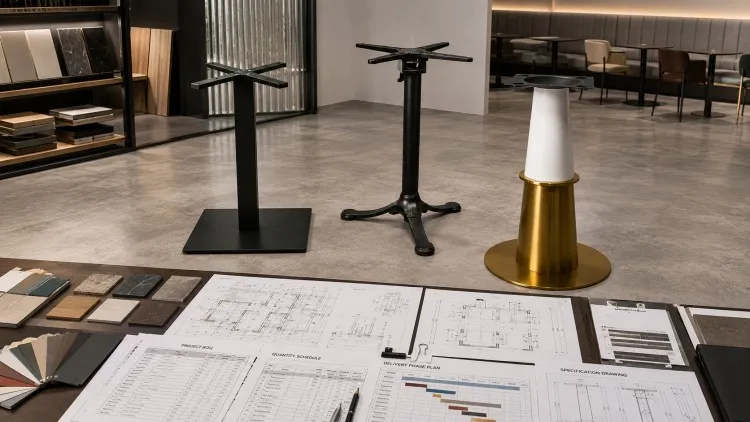
Contract furniture projects are different from simple stock orders because the table base must coordinate with the project drawings, tabletop schedule, finish requirements, installation plan and delivery sequence.
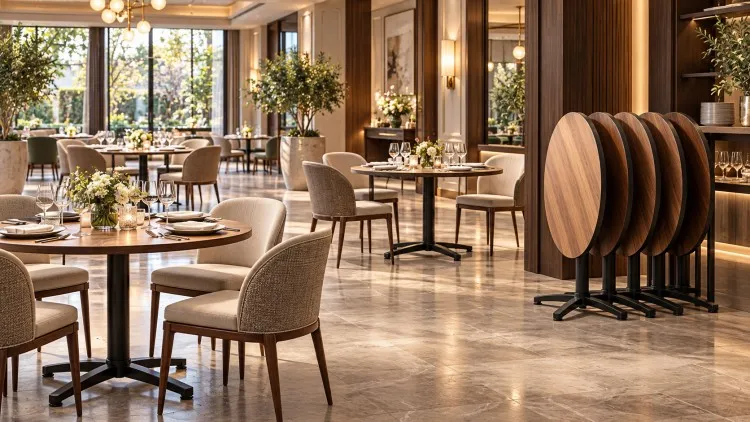
A restaurant, hotel, office, public dining area or mixed-use development may use several table base types within one project.
For this reason, buyers should not evaluate table bases only by unit price or product appearance.
The project specification should connect each table base to a defined location, tabletop, quantity, finish, packing method and approval status.
2. Start With the Project Scope
Before requesting models or prices, the buyer should divide the project into clear application zones.
A single contract furniture project may include restaurant dining, café seating, banquet areas, meeting spaces, lounges, office cafeterias, outdoor terraces and flexible event areas.
Project scope information should include:
- Project name
- Property or customer name
- Location or target market
- Application area
- Indoor or outdoor use
- Number of venues or floors
- Required table quantities
- Planned installation date
- Delivery phases
- Whether products will be reordered later
This information helps the supplier recommend different structures for different project zones instead of quoting one model for the complete project.
3. Prepare a Complete Project RFQ
A project quotation is only useful when the supplier receives enough information to understand the required table configuration.
Buyers should provide the tabletop size, material, quantity, application, preferred base structure, finish and packing requirements at the beginning of the sourcing process.
For a structured starting point, buyers can use the Commercial Table Base RFQ Checklist to organize the information required before requesting a quotation.
A project RFQ should include:
- Project application
- Tabletop size and material
- Approximate tabletop weight
- Required quantity
- Base material
- Base structure
- Dining or bar height
- Required finish
- Sample requirements
- Packing method
- Target delivery date
- Required documents
A clear RFQ reduces unnecessary quotation revisions later in the project.
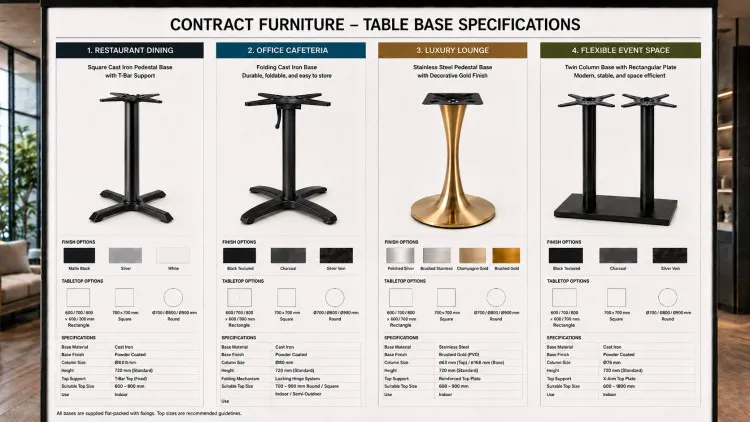
4. Match the Base Structure to the Project Area
Contract projects usually need more than one base structure.
A compact café table, long communal table, luxury lounge table and folding event table have different operational requirements.
| Project Area | Structure Direction |
| Restaurant dining | Pedestal, square base or X-base |
| Café seating | Compact pedestal or folding base |
| Long communal table | Twin-column or multiple support points |
| Banquet or event area | Folding or easy-storage structure |
| Lounge or premium dining | Decorative pedestal design |
| Office cafeteria | Durable, easy-to-clean commercial base |
| Outdoor terrace | Lightweight or corrosion-resistant structure |
The final model should still be checked against the actual tabletop dimensions and project requirements.
5. Use Product-Level References Instead of Only Material Categories
Project buyers can compare specific product structures before locking the final specification.
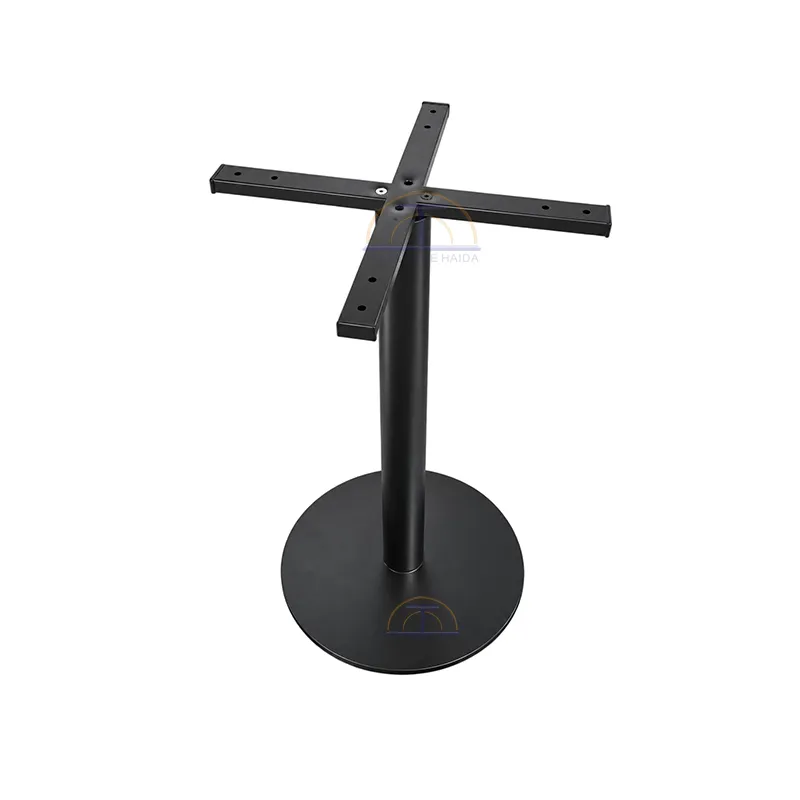
The Modern Square Cast Iron Base HD-J295 is positioned for restaurant and office applications and uses a square cast-iron floor base, making it a useful reference for projects that need a simple commercial pedestal structure.
The Durable Folding Cast Iron Base HD-J233 combines a cast-iron base with a folding structure, making it relevant for restaurant or café projects that need more flexible storage and layout changes.
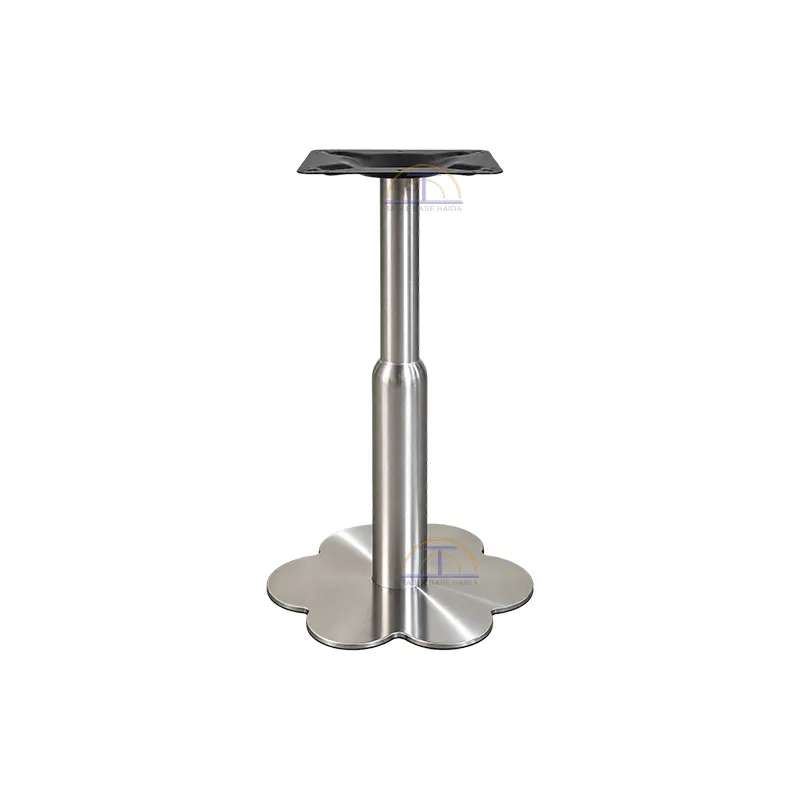
The Modern Two-Tone Tapered Base HD-J214 uses a decorative tapered stainless-steel structure and two-tone finish direction, making it relevant for premium restaurant and hospitality interiors.
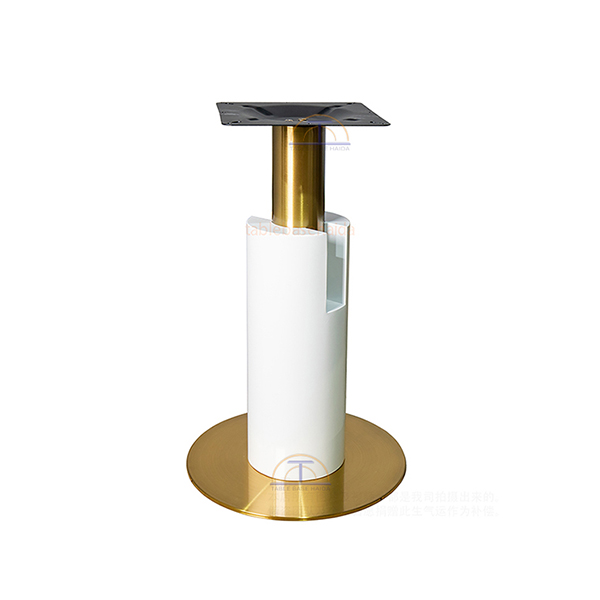
The Modern Two-Tone White & Gold Base HD-J306 provides another decorative stainless-steel direction for cafés, lounges and premium commercial spaces where the table base is part of the visible interior design.
Product references should be used as starting points. The approved project model should match the actual tabletop, quantity, finish and operating conditions.
6. Connect Every Base to a Tabletop Specification
Table base approval should not be separated from tabletop approval.
The supplier needs to know the tabletop dimensions, material, thickness and approximate weight before recommending the final support structure.
Tabletop information should include:
- Shape
- Length and width
- Diameter
- Thickness
- Material
- Approximate weight
- Edge profile
- Mounting method
- Mounting inserts
- Indoor or outdoor use
A base that is suitable for an HPL tabletop may not automatically be suitable for a heavy stone tabletop of the same dimensions.
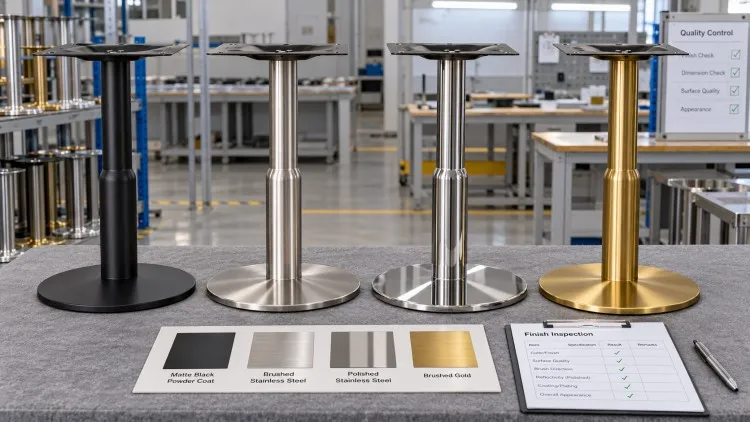
7. Build a Material and Finish Schedule
Contract furniture projects often require several materials or finishes within one property.
The buyer should create a finish schedule so the supplier does not rely on descriptions such as “black,” “gold” or “silver.”
The finish schedule should include:
- Product item code
- Base material
- Finish type
- Color reference
- Matte, sand, brushed, polished or gloss effect
- Approved physical sample
- Hardware color
- Glide color
- Indoor or outdoor requirement
- Approval revision
Finish information should be locked before mass production to reduce batch inconsistencies and rework.
8. Separate Quantities by Item and Area
A project quotation should not show only one total quantity.
The quantity schedule should separate each model by project area and installation phase.
|
Item |
Area | Installed Qty. | Spare Qty. | Phase |
|
TB-01 |
Main restaurant | 60 | 3 | Phase 1 |
|
TB-02 |
Café | 30 | 2 |
Phase 1 |
| TB-03 | Lounge | 18 | 1 |
Phase 2 |
| TB-04 | Event room | 24 | 2 |
Phase 2 |
This structure also makes it easier to control packing, labeling and final delivery.
9. Use a BOQ to Control Project Information
For larger hospitality and contract furniture projects, the BOQ should become the central reference connecting product specifications, quantities and delivery requirements.
The Hospitality FF&E BOQ for Commercial Table Bases provides a related framework for organizing item codes, finishes, tabletop matching, spare parts, packing and delivery phases.
The project BOQ should control:
- Item code
- Product model
- Tabletop reference
- Quantity
- Finish
- Packing
- Spare parts
- Installation responsibility
- Required documents
- Delivery phase
- Current approval status
All parties should work from the latest approved BOQ revision.
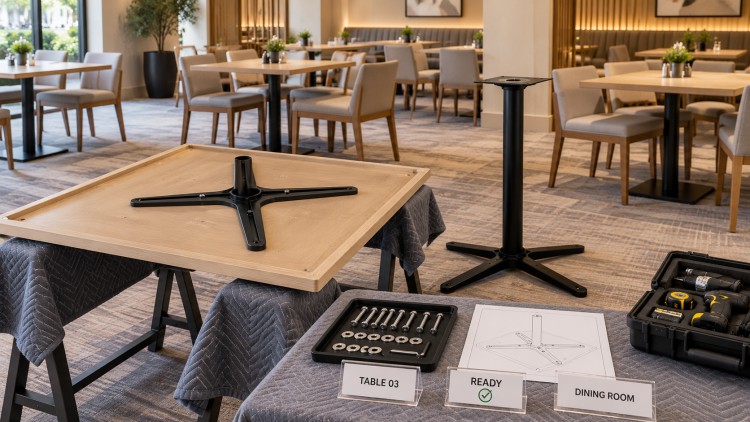
10. Confirm Sample and Mock-Up Requirements
Project buyers should decide which products require physical samples before mass production.
Not every standard product needs a complete custom sample, but new finishes, decorative models, custom dimensions and special tabletop combinations usually require more careful review.
Sample review can include:
- Overall dimensions
- Base footprint
- Column alignment
- Top plate
- Hole positions
- Finish and color
- Tabletop installation
- Final stability
- Hardware bag
- Packing method
The approved sample should be identified clearly so production can follow the same version.
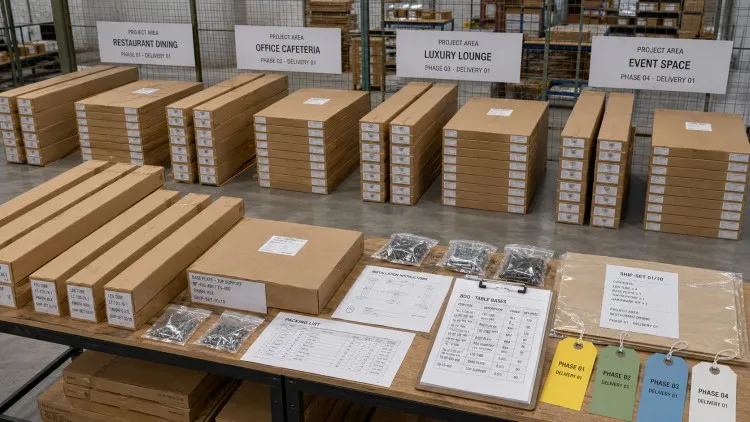
11. Define Packing by Project Area
Contract furniture packing should support installation, not only transportation.
If several table base models are shipped together, the cartons should make it easy for the project team to identify which products belong to each venue or floor.
Packing information can include:
- Item code
- Product model
- Project area
- Quantity per carton
- Carton sequence
- Hardware bag reference
- Assembly instruction
- Finish code
- Delivery phase
- Ship-set number
Good project packing reduces sorting work after the goods arrive on site.
12. Clarify Installation Responsibility
The table base supplier, tabletop supplier and local installer may be different companies.
The project should define who is responsible for each installation step before shipment.
Responsibility should cover:
- Base assembly
- Mounting hardware
- Tabletop fixing
- On-site leveling
- Floor fixing when required
- Removal of protective materials
- Final stability check
- Installation sign-off
Unclear installation responsibility can create delays even when the product itself is correct.
13. Plan Spare Parts Before Handover
Contract furniture projects should include a small spare-parts plan before final handover.
This is especially useful when the same table base model is installed across many rooms, stores or public areas.
Typical spare parts can include:
- Leveling glides
- Adjustable feet
- Screws
- Bolts
- Washers
- Nuts
- Hardware bags
- Model-specific replacement components
The buyer should also record which project item code each spare part belongs to.
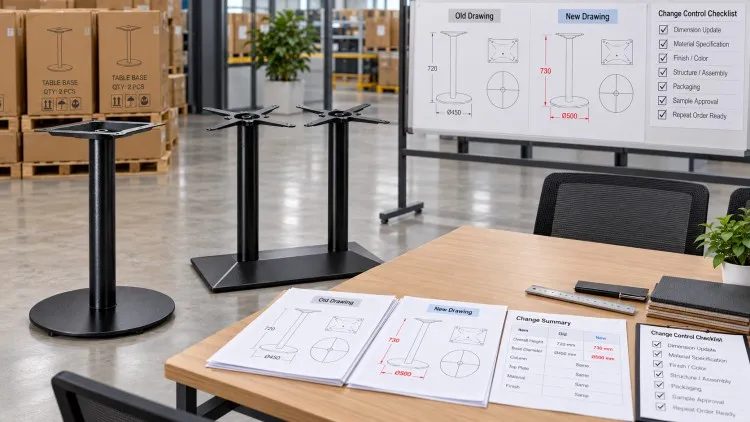
14. Control Substitutions and Design Changes
Project specifications can change during design development, budgeting and site coordination.
A supplier should not replace an approved model with another product only because the new model looks similar.
Any substitution should confirm:
- Reason for substitution
- New product model
- Dimensional differences
- Material differences
- Finish differences
- Tabletop compatibility
- Packing differences
- Price impact
- Lead-time impact
- Written approval
The BOQ and drawings should be updated after the substitution is approved.
15. Request the Right Project Documents
Project buyers often need more than a commercial invoice and packing list.
Supplier documents may include:
- Product specification sheet
- Technical drawing
- Finish approval reference
- Sample approval record
- Assembly instruction
- Packing drawing
- Carton mark
- Product photos
- Packing photos
- Inspection records
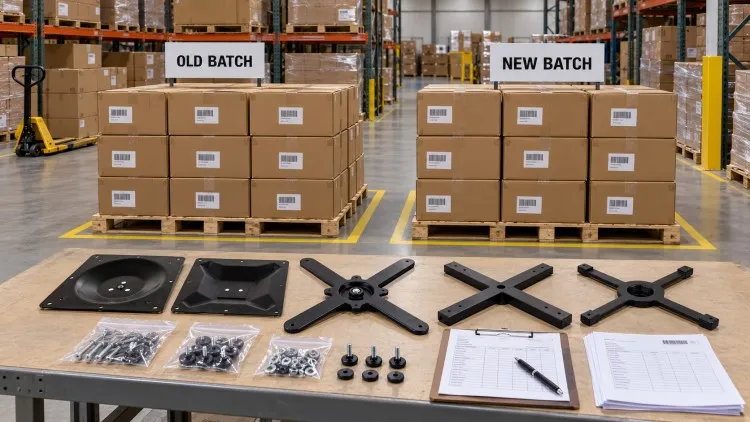
- Batch information
- Loading photos
The required document list should be confirmed before production instead of being requested after shipment.
16. Compare Suppliers Beyond Unit Price
The lowest unit price does not always produce the lowest project cost.
Project buyers should compare the complete sourcing package.
Supplier comparison should include:
- Product specification accuracy
- Sample support
- Finish consistency
- Tabletop matching support
- Packaging quality
- Mixed-model production capability
- Project labeling
- Spare-parts support
- Documentation
- Lead-time control
- Change-management response
- After-sales communication
A slightly cheaper base can become more expensive if it creates rework, site sorting, replacement freight or installation delays.
17. Common Contract Furniture Procurement Mistakes
Many project problems begin with incomplete information rather than product manufacturing itself.
Common mistakes include:
- Using one base model for every project area
- No tabletop information in the RFQ
- No unique item codes
- Finish described only by color name
- No approved sample reference
- Quantities not separated by area
- Packing not matched to installation phases
- Installation responsibility not defined
- No spare parts plan
- Substitutions made without written approval
- Different teams using different BOQ versions
A good procurement workflow connects the product specification with the project execution process.
18. How Haida Supports Contract Furniture Projects
Haida supports restaurant, hotel, café, office and commercial project buyers with different table base materials and structures for bulk sourcing.
Project buyers should provide the tabletop schedule, quantity breakdown, preferred finish, application areas and delivery phases before final model confirmation.
To discuss a contract furniture table base project, buyers can contact Haida for project sourcing support with the BOQ, drawings and target delivery schedule.
19. FAQ
Q1: What information should a contract furniture buyer send before requesting a table base quote?
The buyer should provide the project application, tabletop size and material, quantity, preferred base structure, finish, delivery schedule and packing requirements.
Q2: Should one project use only one table base model?
Not necessarily. Different areas may require different structures because tabletop sizes, layouts, appearance requirements and storage needs can vary.
Q3: Why should table bases and tabletops be approved together?
The tabletop dimensions, material, weight and fixing method affect the required base footprint, support structure and mounting method.
Q4: Should spare parts be included in a project order?
For large projects, a basic spare-parts plan can reduce maintenance delays after handover, especially when the same model is used in multiple areas.
Q5: What should buyers compare besides unit price?
Compare specification accuracy, finish consistency, sample support, packing, documentation, lead time, spare parts and after-sales response.
20. Conclusion
Contract furniture table base procurement should connect product selection with the complete project workflow.
Buyers should define the project zones, tabletop specifications, product models, finishes, quantities, samples, packing, installation responsibility and delivery phases before mass production.
Specific product pages can help buyers compare structures, while the final approval should always be based on the actual project configuration.
When the supplier and project team work from the same approved RFQ, BOQ and drawings, the sourcing process becomes easier to control from quotation through installation.