1. Why Load Capacity Needs More Than One Number
Table base load capacity is often treated as a single weight value, but commercial buyers need more information than a maximum kilogram figure.
A base may support the vertical weight of a tabletop while still performing poorly when the top is too wide, the load is uneven or pressure is applied near the edge.
Commercial performance depends on the complete table system: tabletop material, dimensions, weight distribution, base footprint, column structure, mounting plate, fasteners, floor condition and expected use.
For this reason, buyers should not approve a table base only because a supplier describes it as “heavy-duty.”
2. Separate Load Capacity From Stability
Load capacity and stability are related, but they are not the same measurement.
Load capacity describes whether the structure can support an applied weight without permanent deformation, connection failure or structural damage.
Stability describes whether the completed table resists wobbling, rocking, sliding or tipping during normal commercial use.
A structurally strong column may carry a heavy top, but a narrow floor plate may still create tipping risk when users lean on the tabletop edge.
A complete product review should therefore consider both structural load and operational stability.
3. Understand the Main Types of Load
Commercial tables experience more than the dead weight of the tabletop.
Buyers should consider several types of load when preparing specifications.
The main load types include:
- Tabletop dead load
- Centrally placed service load
- Uneven load on one side
- Edge pressure from a user leaning on the table
- Horizontal force during cleaning or repositioning
- Repeated vibration and movement in high-traffic use
- Temporary impact from objects being placed on the table
- Additional force created by an oversized tabletop
A table base should be evaluated for the types of force expected in its real application, not only a controlled vertical load.
4. Record the Tabletop Before Selecting the Base
The supplier cannot recommend a reliable table base without knowing the tabletop specification.
Two tabletops with the same length and width may have very different weights because of differences in material and thickness.
The buyer should provide:
- Tabletop shape
- Length and width
- Diameter for round tops
- Thickness
- Material
- Actual or estimated weight
- Edge profile
- Mounting inserts or fixing method
- Expected items placed on the table
- Indoor, covered outdoor or open outdoor use
Wood, HPL, laminate, glass, artificial marble, natural stone and sintered stone should not automatically use the same base recommendation.
5. Calculate the Complete Supported Weight
The tabletop is only one part of the supported load.
The procurement specification should consider the estimated total working weight placed on the table.
A practical review can include:
| Weight Component | Example |
|---|---|
| Tabletop weight | 45 kg |
|
Equipment or display items |
12 kg |
| Normal service items | 8 kg |
| Temporary operating allowance | 15 kg |
| Estimated working load |
80 kg |
This example does not create a universal required rating. It shows why buyers should calculate the intended operating condition before requesting confirmation from the supplier.
The final base approval should use the project’s actual tabletop, application and safety requirements.
6. Do Not Confuse Base Weight With Load Capacity
A heavier table base often provides a lower center of gravity, but product weight alone does not prove load capacity.
Base weight may improve resistance to tipping and movement, especially for pedestal tables.
However, structural performance also depends on material thickness, column dimensions, welds, castings, connection points, top plate and fasteners.
A buyer should request both the base weight and the supplier’s recommended tabletop specification instead of assuming that the heaviest model is automatically the most suitable.
7. Evaluate the Base Footprint
The base footprint is the area over which the table contacts the floor.
A larger footprint generally improves resistance to edge pressure and tipping, but it must also allow enough space for chairs, feet and circulation.
Footprint review should include:
- Base diameter
- Base length and width
- Distance between supporting feet
- Tabletop overhang on each side
- Direction of the longest tabletop dimension
- Seating and knee clearance
- Contact points with the floor
- Position of the center of gravity
A wider floor plate may be required for a large rectangular top even when the tabletop weight is moderate.
8. Check the Column Structure
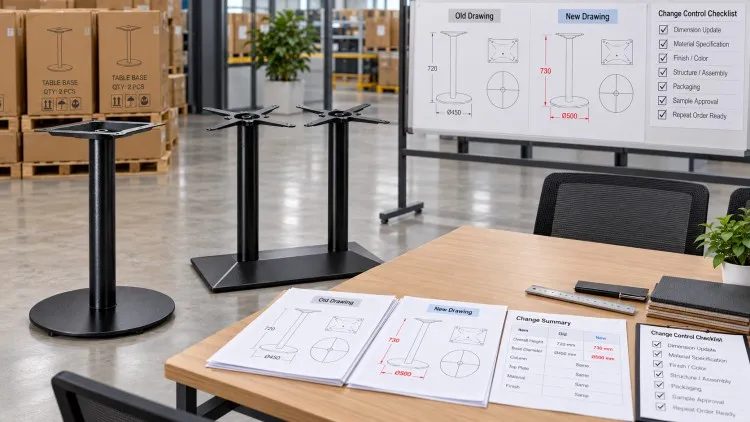
The column transfers load from the mounting plate to the floor base.
Its diameter, profile, thickness, number and connection method all affect structural performance.
Column factors include:
- Round, square or rectangular profile
- Column diameter or section size
- Wall thickness
- Single-column or twin-column structure
- Welded or detachable connection
- Distance between multiple columns
- Bracing or cross support
- Connection with the mounting plate
Long tabletops often benefit from support at more than one point because the load can be distributed over a greater length.
9. Review the Mounting Plate and Fasteners
A strong floor base cannot compensate for an unsuitable mounting plate or weak tabletop connection.
The mounting plate distributes force between the column and tabletop.
Buyers should confirm:
- Mounting plate length and width
- Plate thickness
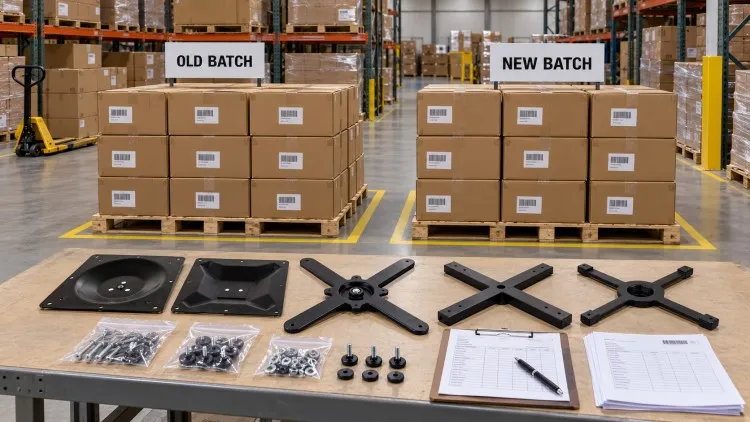
- Number of mounting holes
- Hole diameter and spacing
- Screw type
- Screw length
- Threaded inserts, if required
- Compatibility with the tabletop material
- Whether the top needs an adapter or reinforcing frame
Stone, glass and thin composite tops may require different mounting methods from solid wood or HPL tops.
10. Match the Base Structure to the Application
Different commercial environments create different load and stability requirements.
A small café table, a restaurant booth table, a long communal table and a display table should not automatically use the same base structure.
Typical structural directions include:
| Application | Base Direction to Review |
|---|---|
| Small round café top | Single pedestal with suitable footprint |
| Square restaurant top | Square plate or X-base |
| Long rectangular top | Twin-column or multiple bases |
| Heavy stone top | Wide footprint and reinforced connection |
| Bar-height table | Larger stability margin and controlled overhang |
| Mobile or folding table | Mechanism strength and locked-position testing |
These are review directions rather than universal size rules. The final model should be confirmed using actual project information.
11. Product-Level Examples for Different Support Requirements
Product pages can help buyers compare structures, but they should not be treated as universal load certificates.
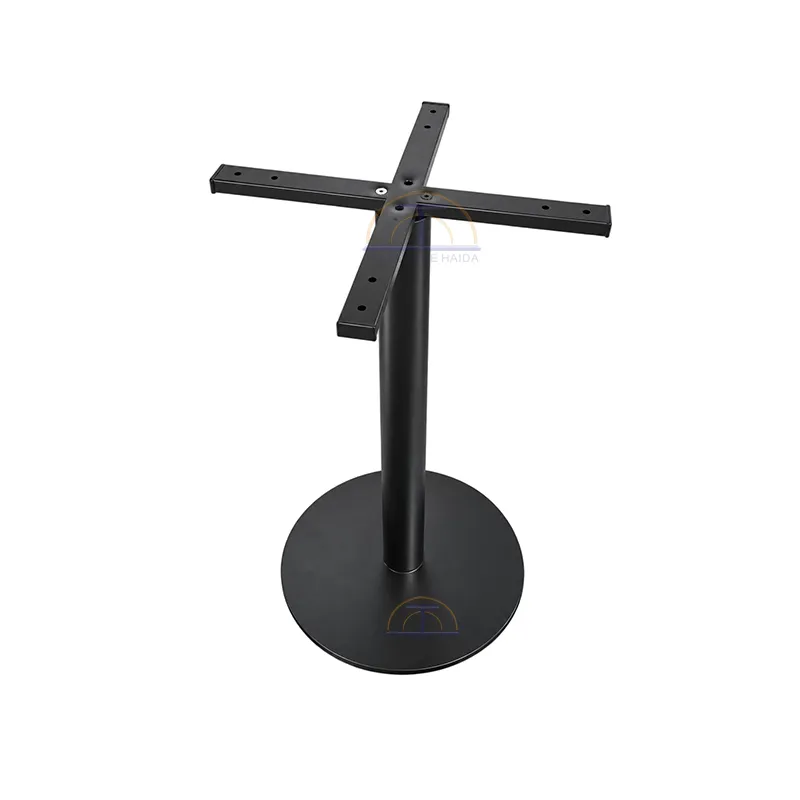
The Heavy-Duty Steel Table Base HD-J300 is positioned for large dining applications. Its published specifications list a 720 mm height, a 450 mm top plate and a high-quality steel structure, making it a relevant model to review when a buyer needs a larger commercial dining base.
The Heavy-Duty Steel Rectangular Base HD-J114 provides several floor-base size options and dining or bar-height configurations. It is useful when the BOQ needs a rectangular support direction or when the buyer wants to compare how different footprint sizes affect the final table specification.
The Heavy-Duty Pedestal Table Base HD-J068 lists 430 mm and 550 mm base options, 300 mm and 450 mm top plates, and suggested tabletop diameters of 600 mm, 700 mm and 800 mm. This illustrates why base size and mounting plate should be matched to the tabletop instead of evaluating material alone.
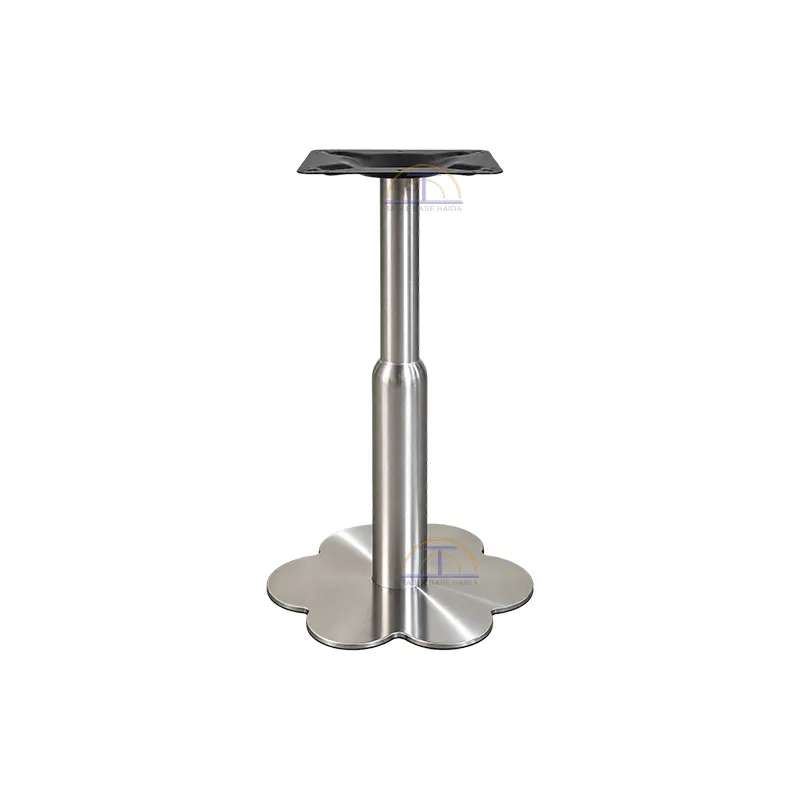
The HD-J124 Square Stainless Steel Pedestal Table Base is available with several square or rectangular base sizes and dining or bar heights. It is a useful example of why one product family may still require different specifications for different tabletops and operating heights.
The buyer should request a model-specific recommendation and test basis rather than copying one product specification into every project.
12. Ask What the Supplier Means by “Load Capacity”
Suppliers may calculate or describe load capacity in different ways.
A figure is difficult to compare unless the buyer knows how it was obtained.
The buyer should ask:
- Is the value for the base alone or the completed table?
- Does it include the tabletop weight?
- Is the load placed centrally or across the full surface?
- Is it a temporary test load or recommended working load?
- How long was the load maintained?
- Was edge pressure tested?
- Was the test completed at dining or bar height?
- Which tabletop size and material were used?
- Were all fasteners and glides installed?
- What acceptance criteria were used?
Without this information, two suppliers may provide similar numbers that describe very different test conditions.
13. Distinguish Test Load From Working Load
A short-term test load should not automatically become the recommended daily working load.
Test conditions may be controlled, while commercial tables experience repeated movement, edge pressure, cleaning, repositioning and uneven loading.
A specification should distinguish:
- Maximum test load
- Recommended working load
- Tabletop weight allowance
- Temporary service load
- Safety margin
- Test duration
- Number of repeated cycles
- Pass or fail criteria
Commercial buyers should base the purchase decision on the recommended operating condition rather than the highest number shown in a sales document.
14. Include Stability and Tipping Tests
Vertical load testing alone does not show how the table behaves when pressure is applied away from the center.
A practical stability review can include:
- Downward pressure near the tabletop edge
- Horizontal push from different directions
- Rocking test on a level floor
- Glide adjustment test
- Tabletop rotation or twisting force
- Stability with the approved tabletop attached
- Stability at full intended height
- Comparison before and after repeated assembly
The test should use the actual or representative tabletop whenever possible.
15. Pay Extra Attention to Bar-Height Tables
Increasing the table height raises the tabletop and can increase the effect of horizontal force.
A base that performs well at dining height should not automatically be approved for bar height without review.
Bar-height review should include:
- Overall center of gravity
- Base footprint
- Column stiffness
- Tabletop overhang
- Top weight
- Edge pressure
- Footrest or additional components
- Floor condition
- Final assembled stability
Dining and bar-height versions should be listed as separate specifications in the quotation and BOQ.
16. Consider Repeated Commercial Use
Commercial tables are assembled, cleaned, moved and used more frequently than typical residential tables.
A one-time static test may not identify problems caused by repeated use.
Repeated-use review can include:
- Repeated tightening and loosening of bolts
- Repeated tabletop loading
- Movement across the floor
- Glide wear
- Connection looseness
- Weld inspection after cycles
- Folding or adjustment cycles
- Surface damage around connection points
Buyers sourcing for restaurant chains or hospitality projects should confirm whether the tested configuration represents long-term commercial use.
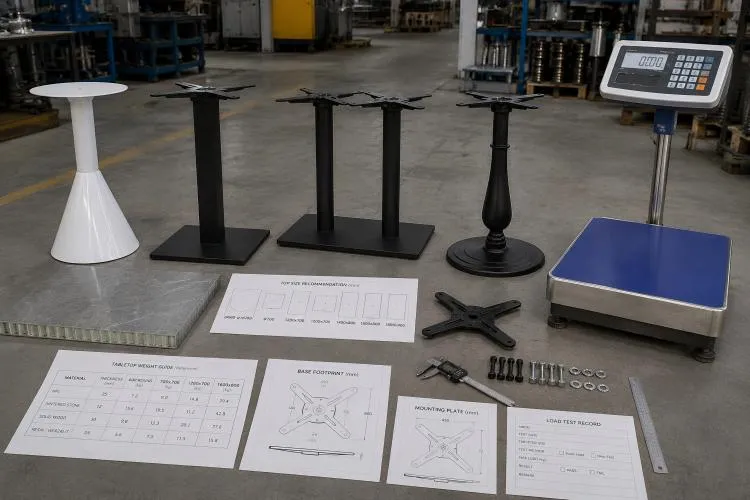
17. Build a Load and Stability Approval Sheet
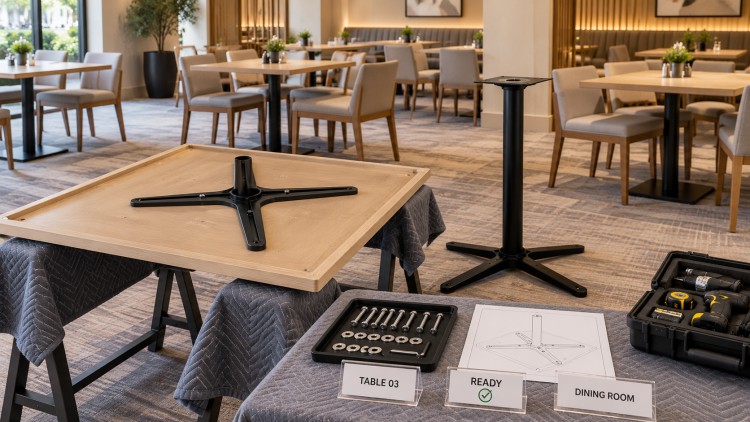
A simple approval sheet can prevent different teams from using different assumptions.
The approval sheet should include:
|
Approval Field |
Required Information |
| Base model |
Supplier model and buyer SKU |
|
Tabletop |
Material, size, thickness and weight |
|
Base dimensions |
Floor footprint and height |
| Column |
Profile, quantity and connection |
|
Top plate |
Size, hole layout and thickness |
| Fasteners |
Type, size and quantity |
|
Test load |
Weight, position and duration |
| Stability test |
Edge and horizontal force method |
| Result |
Pass, revise or reject |
|
Approved version |
Drawing and sample reference |
This record should match the final mass-production specification.
18. Common Load Capacity Purchasing Mistakes
Many load-related problems begin before production because the buyer and supplier are evaluating different table configurations.
Common mistakes include:
- Asking for a load number without providing the tabletop
- Treating base weight as proof of load capacity
- Ignoring tabletop overhang
- Testing only at the center of the tabletop
- Using a dining-height result for a bar-height version
- Ignoring mounting plate and screw specifications
- Using one base for several different tabletop materials
- Approving a long top with only one central support point
- Treating a temporary test load as a daily working load
- Failing to record the tested product version
A useful load specification should describe the complete table and the conditions under which it was evaluated.
19. How Haida Supports Load and Stability Review
Haida can support commercial buyers with table base model selection, tabletop matching, base-size review, mounting-plate confirmation and sample evaluation.
Buyers should provide the tabletop dimensions, material, estimated weight, operating height, quantity and application before requesting a load or stability recommendation.
To review a commercial table configuration, buyers can contact Haida for table base load and stability support with the tabletop drawing, base model and intended use.
20. FAQ
Q1: Is table base load capacity the same as tabletop weight?
No. The base may also need to support equipment, service items and temporary operating loads, while resisting edge pressure and horizontal movement.
Q2: Does a heavier base always support a heavier tabletop?
Not always. Base weight can improve stability, but structural performance also depends on the footprint, column, mounting plate, fasteners and tabletop dimensions.
Q3: What information should I send before asking for a load recommendation?
Send the tabletop shape, size, thickness, material, weight, operating height, application and preferred table base model.
Q4: Should bar-height bases use the same load specification as dining bases?
They should be reviewed separately because the increased height changes the center of gravity and response to horizontal or edge forces.
Q5: Is a vertical load test enough?
Usually not for a complete commercial evaluation. Buyers should also review edge pressure, horizontal movement, tipping resistance and the final installed tabletop.
21. Conclusion
Table base load capacity cannot be understood from one weight number alone.
Commercial buyers should evaluate the tabletop, total working load, base footprint, column structure, mounting plate, fasteners, table height and actual operating conditions.
The supplier should explain how the load figure was tested and whether it represents a temporary test load or a recommended working condition.
When the complete table configuration is recorded and tested, the buyer can select a more appropriate base and reduce structural, stability and after-sales risks.