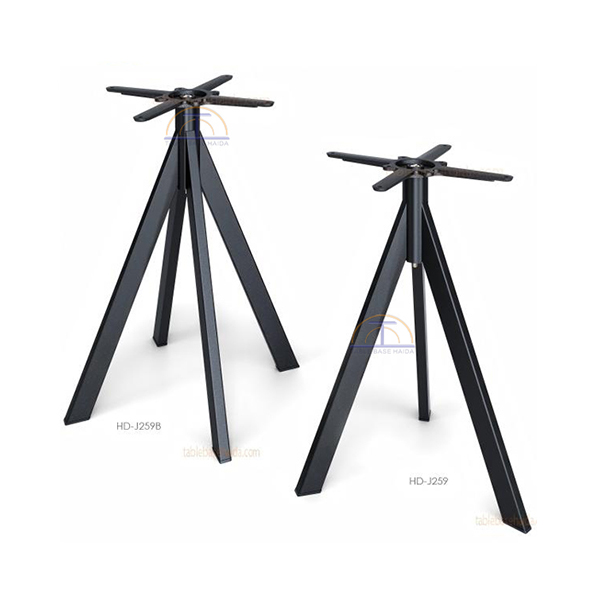
1. Why Private Label Packaging Matters for OEM Table Base Orders
For OEM table base buyers, packaging is not only used to protect the product during shipping. It also affects warehouse handling, retail distribution, brand presentation, installation efficiency and after-sales tracking.
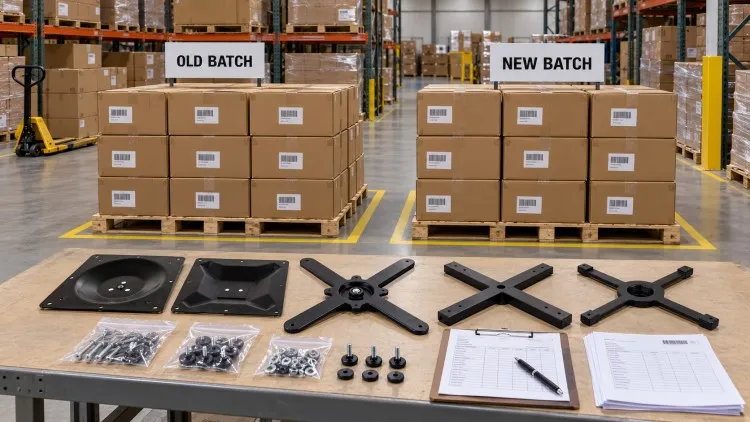
A table base may be structurally correct, but if the carton mark is unclear, the barcode is wrong, the manual is missing or the hardware bag is not labeled, the buyer may still face warehouse confusion and customer complaints.
For importers, furniture brands and wholesalers, private label packaging should be confirmed before mass production, not after the goods are packed.
2. Confirm the Packaging Purpose First
Before designing carton marks or labels, buyers should confirm how the table base order will be distributed.
A dealer stock order, restaurant project order, e-commerce order and OEM brand order may require different packaging information. Some buyers need simple export cartons, while others need retail-ready labels, barcode stickers, multilingual manuals or batch tracking.
Packaging purpose should clarify:
- Dealer warehouse stock
- Restaurant or hotel project delivery
- Retail or online sales
- OEM brand distribution
- Mixed-model container loading
- Replacement or spare parts support
When the packaging purpose is clear, the supplier can prepare carton marks, labels and manuals in a more practical way.
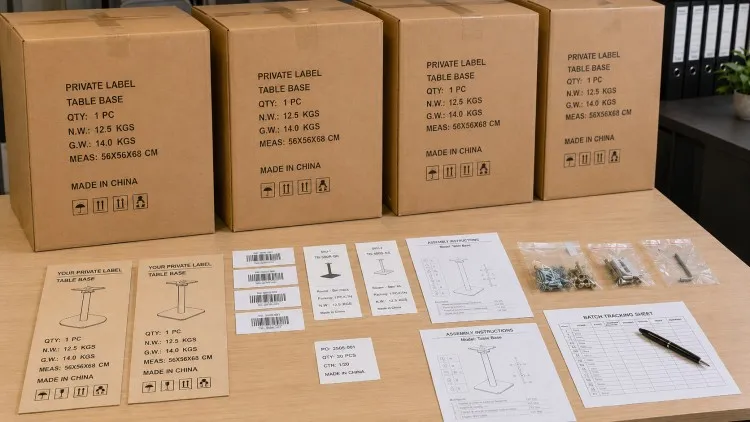
3. Set a Standard Carton Mark Format
Carton marks help buyers identify products quickly during loading, customs clearance, warehouse storage and final delivery.
For OEM table base orders, carton marks should be simple, consistent and easy to read. They should not include too much unnecessary information, but they must include the key details needed by the buyer’s warehouse and sales team.
A standard carton mark can include:
- Buyer brand or private label name
- Product model
- SKU code
- Product description
- Quantity per carton
- Carton number
- Net weight and gross weight
- Carton size
- Country of origin, if required
For example, a carton mark for a commercial table base order may include model number, finish, height and packing version.
4. Use SKU Codes That Match the Buyer’s System
SKU codes should connect the product, carton, barcode, invoice, warehouse sheet and reorder record.
If the supplier uses one code and the buyer uses another code without clear matching, warehouse teams may make mistakes during stock receiving, picking or replacement parts handling.
A useful SKU code can include material, base type, height, finish and packing version.
Example SKU code:
`CI-X-720-BK-KD`
This code can represent cast iron, X-base, 720 mm height, black finish and KD packing.
This type of code can be used on carton marks, product labels, order sheets and reorder communication.
5. Confirm Barcode Label Requirements
Barcode labels are important for buyers who manage table bases through warehouse systems, retail channels or online platforms.
Before mass production, buyers should confirm barcode format, label size, placement, printing quality and whether the barcode should appear on the carton, product, hardware bag or instruction sheet.
Barcode details to confirm:
- Barcode format
- SKU or item number
- Label size
- Label material
- Carton label position
- Product label position
- Scannability after printing
- Whether barcode must match buyer system
For mixed orders with different models, barcode control is especially important because similar table bases may look close in shape but have different height, finish or packing.
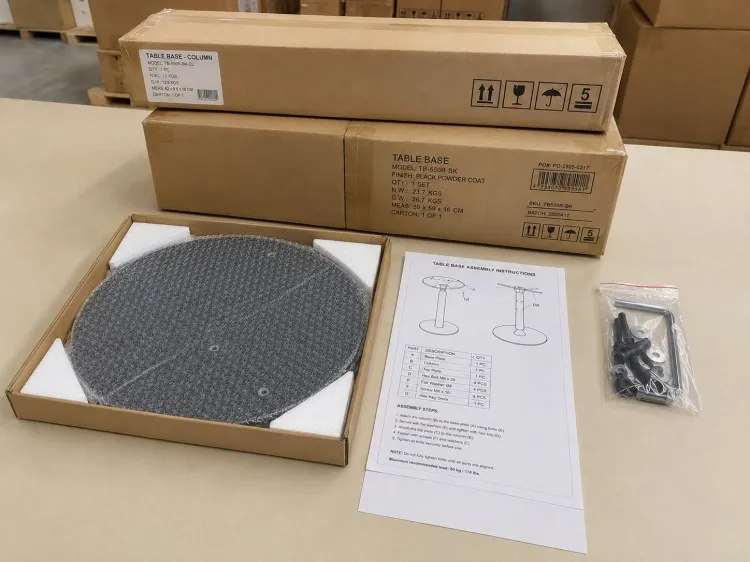
6. Prepare Clear Product Labels
Product labels help identify table bases after the carton is opened.
For dealers and project buyers, product labels are useful when products are stored separately from the original carton or when multiple models are installed at the same project site.
A product label can include model number, SKU, finish, height, production batch and inspection status.
Product label information can include:
- Model number
- SKU code
- Product name
- Finish or color
- Height
- Batch number
- Inspection mark
- Buyer brand, if required
For premium table bases or private label orders, the label should look clean and match the buyer’s brand standard.
7. Standardize Hardware Bag Labels
Hardware bags are small, but they often create after-sales problems when they are missing, mixed or unclear.
For OEM table base orders, hardware bags should be packed and labeled according to the approved product model.
The hardware bag label should help installers identify whether the screws, bolts, washers, glides or spare parts match the table base model.
Hardware bag label should include:
- Matching product model
- Hardware bag code
- Part names
- Quantity of each part
- Installation step reference
- Spare parts note, if included
A labeled hardware bag reduces installation mistakes and helps dealers provide replacement parts more easily.
8. Create a Practical Assembly Manual
An assembly manual should help the end user install the table base correctly without unnecessary questions.
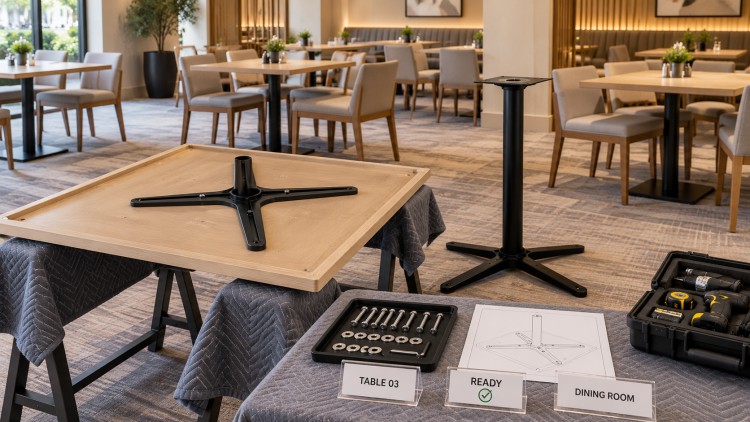
For KD-packed table bases, the manual should match the actual parts, hardware bag and packing method.
If the buyer sells table bases through dealers, online platforms or project contractors, a clear manual can reduce installation errors and after-sales communication.
Assembly manual should include:
- Product model
- Parts list
- Hardware list
- Step-by-step assembly images
- Screw position notes
- Leveling adjustment method
- Tabletop mounting notes
- Maintenance notes
The manual should be checked against the real sample before mass production.
9. Decide Whether Multilingual Manuals Are Needed
Multilingual manuals may be required when table bases are sold in different markets or through retail and online channels.
A simple English manual may be enough for some B2B project orders. However, buyers selling to Europe, North America, the Middle East or multiple regions may need additional languages.
Manual language planning should confirm:
- Target market
- Required languages
- Safety notes
- Installation terms
- Product warnings
- Brand tone and layout
- Whether translation is provided by buyer or supplier
To avoid translation mistakes, buyers should approve the manual layout and wording before printing.
10. Use Batch Tracking for OEM Orders
Batch tracking helps buyers trace products after delivery.
For OEM table base orders, batch information can be used in warranty claims, replacement part requests, quality checks and reorder planning.
Batch tracking does not need to be complicated. It can be included on carton labels, product labels, inspection stickers or internal packing records.
Batch tracking can include:
- Production date
- Order number
- Batch number
- Product model
- Inspector code
- Packing date
- Customer order reference
When a buyer needs to identify a problem later, batch tracking makes communication faster and more specific.
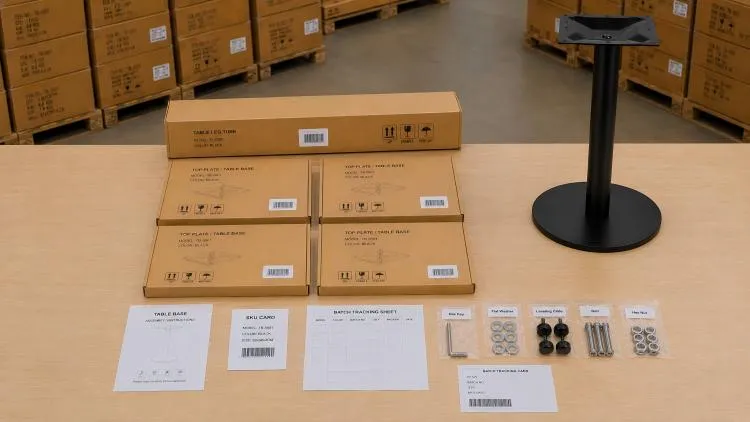
11. Match Packaging With Different Table Base Categories
Different table base categories may need different packaging details.
For stable indoor restaurant orders, cast iron table bases may need strong cartons, edge protection and clear weight labels. For outdoor or café projects, aluminum table bases may need packaging that protects the finish while supporting easier handling.
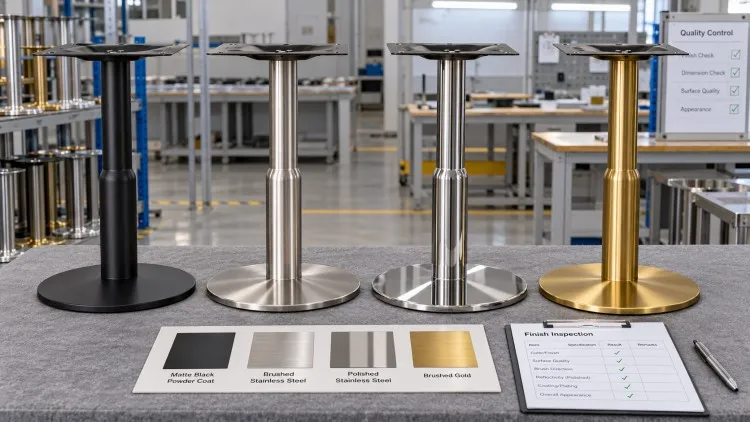
For higher-end dining or food-service environments, stainless steel table bases should be packed carefully to protect brushed or polished surfaces.
If table bases are shipped together with HPL table tops, the carton marks and SKU labels should make it clear which base matches which tabletop.
12. Approve Packaging Samples Before Mass Production
Packaging samples should be approved before mass production, especially for OEM orders, private label cartons and barcode labels.
Buyers should review printed carton marks, barcode labels, manuals and hardware bag labels before bulk packing starts.
Packaging approval should check:
- Carton mark content
- Barcode scannability
- Label position
- Manual accuracy
- Hardware bag label
- Brand logo usage
- Batch code position
- Packing protection
Approving packaging samples early helps avoid reprinting, relabeling and shipment delays.
13. Common Packaging Mistakes to Avoid
Many OEM packaging problems are caused by small details.
A wrong SKU code, unclear carton mark or missing manual may not affect the table base structure, but it can affect warehouse receiving, installation and customer experience.
Common mistakes include:
- Carton mark does not match purchase order
- Barcode cannot be scanned
- Hardware bag has no label
- Manual does not match actual parts
- Mixed models use similar cartons without clear SKU
- Batch information is missing
- Private label logo is used incorrectly
- Spare parts are packed without identification
These problems can be reduced when packaging details are confirmed before production.
14. How Haida Supports OEM Table Base Packaging
For OEM buyers, table base packaging should connect product specifications, carton marks, barcode labels, hardware bags, manuals and batch tracking.
Haida can support buyers with OEM table base packaging details based on product model, order quantity, target market and private label requirements.
Buyers can compare different product categories, including cast iron table bases, aluminum table bases, stainless steel table bases and HPL table tops, before confirming the final packaging plan.
To discuss OEM carton marks, barcode labels or assembly manuals for a table base order, buyers can contact Haida for OEM table base packaging support with model number, target market, label requirements and packing method.
15. FAQ
Q1: What should be included on a table base carton mark?
A table base carton mark should usually include buyer brand, model number, SKU code, product description, quantity, carton number, weight, carton size and origin information if required.
Q2: Why are barcode labels important for OEM table base orders?
Barcode labels help buyers manage receiving, warehouse storage, picking, retail distribution and reorder communication more accurately.
Q3: Should hardware bags have labels?
Yes. Labeled hardware bags help installers identify the correct screws, bolts, glides and replacement parts for each table base model.
Q4: When should assembly manuals be approved?
Assembly manuals should be approved before mass production and bulk packing, especially for KD-packed table bases and OEM private label orders.
Q5: How does batch tracking help after shipment?
Batch tracking helps buyers identify production records, manage warranty claims, request replacement parts and communicate quality issues more clearly.
16. Conclusion
Private label packaging is an important part of OEM table base orders.
A good packaging system should include clear carton marks, accurate SKU codes, scannable barcode labels, labeled hardware bags, practical manuals and batch tracking.
For importers, wholesalers and furniture brands, packaging details should be confirmed before mass production to avoid warehouse confusion, installation problems and after-sales delays.
When packaging information is consistent from product to carton to warehouse system, OEM table base orders become easier to receive, sell, install and reorder.